
Meet S/2023 U1
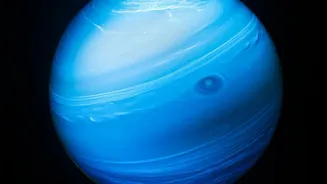
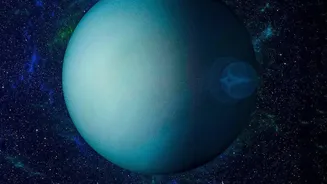
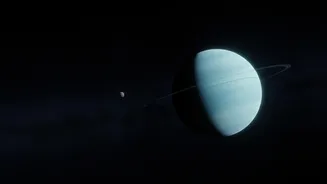
The newest addition to Uranus’s family of satellites has been provisionally named S/2023 U1. Announced in February 2024 by the International Astronomical Union's Minor Planet Center, this discovery brings the total count of known Uranian moons to 28.
This is the first new moon found around the ice giant since 2003. With an estimated diameter of only about 8 kilometres, it is likely the smallest of the planet's moons, a faint speck in the vastness of the outer solar system. In keeping with astronomical tradition for the planet, S/2023 U1 will eventually be given a permanent name from the works of William Shakespeare.
The Art of Finding a Faint Moon
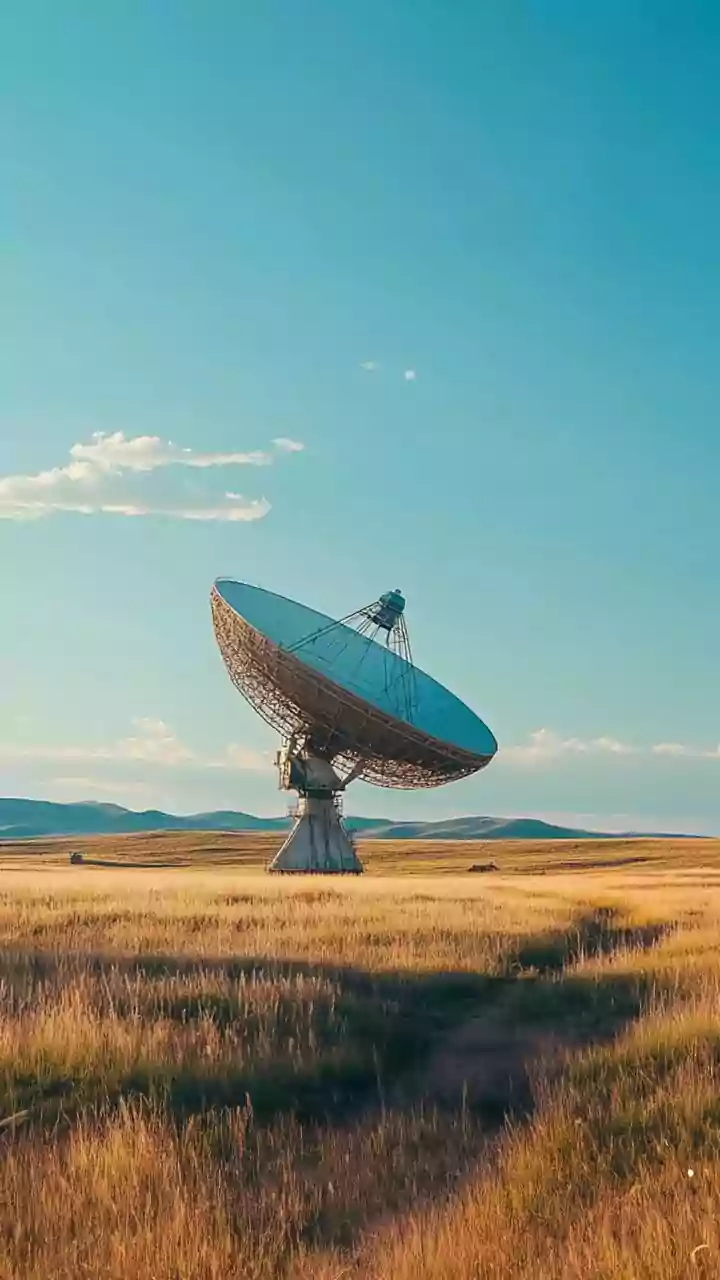
Finding such a small and distant object is a monumental feat of astronomy. The discovery was led by Scott S. Sheppard of the Carnegie Institution for Science, a renowned moon-hunter who has been involved in identifying numerous satellites across the solar system. Sheppard and his team first spotted S/2023 U1 on November 4, 2023, using the powerful 6.5-meter Magellan telescopes at Las Campanas Observatory in Chile. To find it, they used a special image processing technique where multiple long-exposure images are taken and then layered together. By aligning the images to follow Uranus's movement, background stars and galaxies appear as trails, while any object orbiting the planet, like a moon, reveals itself as a single point of light. After the initial sighting, Sheppard conducted follow-up observations and was able to find the moon in older images taken in 2021, which helped confirm its orbit.
An Orbit from the Edge
What makes S/2023 U1 particularly interesting to scientists is its orbit. It takes the tiny moon a lengthy 680 Earth days to circle Uranus, following a path that is both distant and highly inclined. These characteristics classify it as an 'irregular' moon. Unlike regular moons that are thought to have formed in a disk around their host planet, irregular moons are believed to be captured objects. This means S/2023 U1 was likely a wandering body that got snared by Uranus's powerful gravity, probably during the chaotic, early days of the solar system's formation. Its orbit is similar to two other Uranian moons, Caliban and Stephano, suggesting they may all be fragments of a once-larger parent body that was shattered by a collision long ago.
Why This Tiny Moon Matters
A single, 8-kilometre rock orbiting a planet nearly 3 billion kilometres away might seem insignificant, but each new discovery adds a crucial piece to the puzzle of our solar system's history. The existence and orbital properties of irregular moons like S/2023 U1 provide valuable clues about the environment around the giant planets billions of years ago. Studying these captured remnants helps planetary scientists model the formation and migration of planets like Uranus and Neptune. According to Sheppard, the discovery shows that even Uranus, which is famously tipped on its side, has a moon population similar to the other giant planets, reinforcing theories about planetary system formation. This find also pushes the boundaries of what ground-based telescopes can achieve, demonstrating how advanced technology can continue to unveil secrets hidden in our own cosmic backyard.