


A Day Longer Than a Year
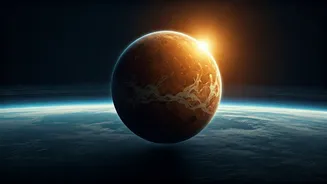
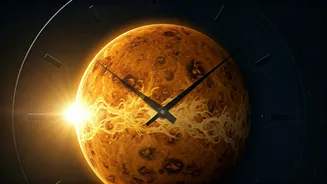
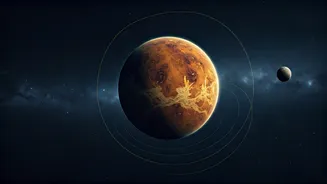
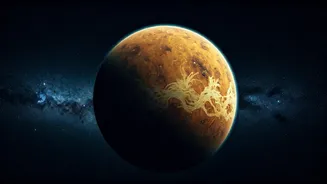
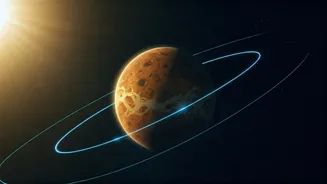
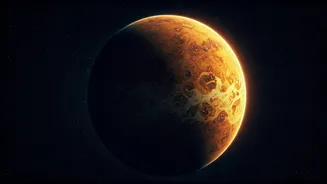
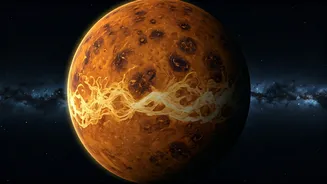
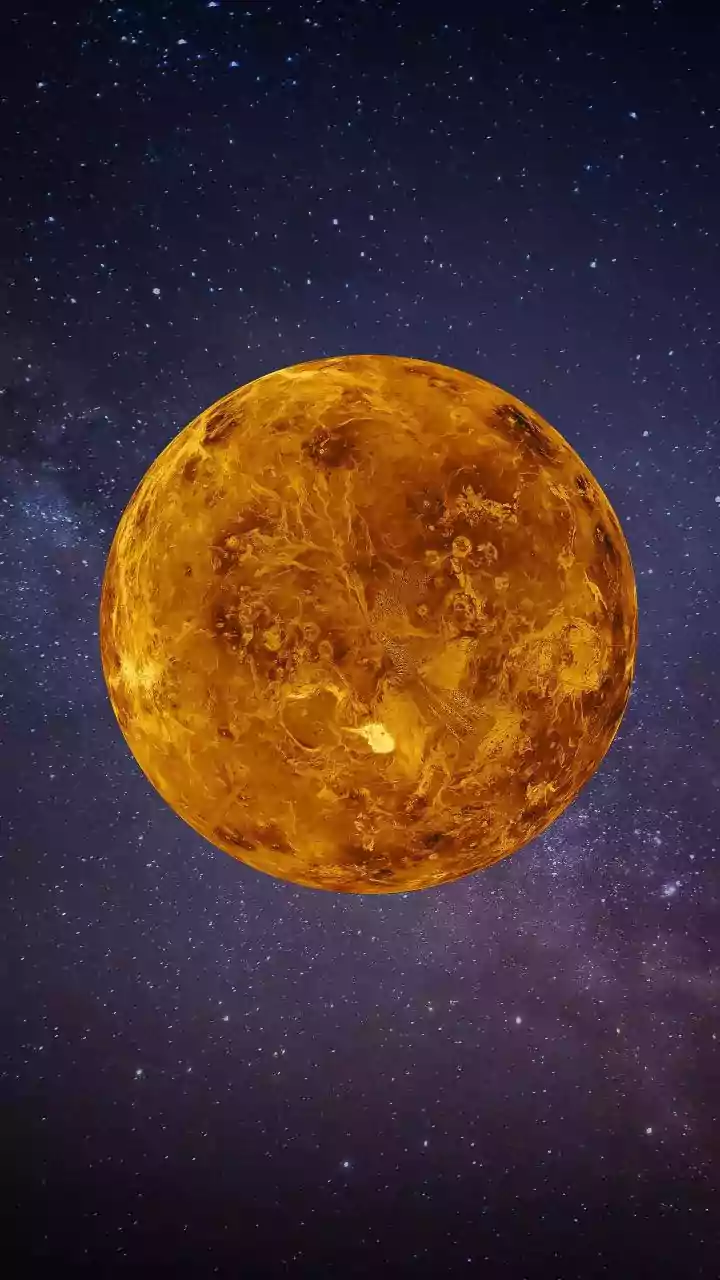
It sounds like a riddle, but it’s a celestial fact. A year on Venus—the time it takes to complete one full orbit around the Sun—is about 225 Earth days. However, a single day on Venus, measured by one full rotation on its axis, takes approximately 243
Earth days. That’s right: a Venusian day is about 18 Earth days longer than its year. This makes Venus the only planet in our solar system with this peculiar characteristic. If you were standing on its surface, you would complete a full trip around the Sun before the planet itself had finished a single spin. This fundamental difference sets the stage for one of the most extreme environments imaginable.
The Slow, Backward Spin
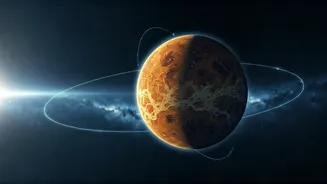
To understand this temporal oddity, we have to look at how Venus spins. Unlike most planets in our solar system, including Earth, Venus has a retrograde rotation. It spins clockwise on its axis, while almost every other planet spins counter-clockwise. Furthermore, its rotation is incredibly sluggish. While Earth zips through a rotation in 24 hours, Venus crawls along, taking 243 Earth days to do the same. This combination of a slow spin and a backward motion is at the heart of its bizarre timekeeping. Scientists are still debating the exact cause. Leading theories suggest a colossal ancient impact knocked it off-kilter, or that the immense gravitational pull of its super-thick atmosphere has, over billions of years, acted as a brake, slowing its spin to a crawl and eventually reversing it.
What About Sunrise and Sunset?
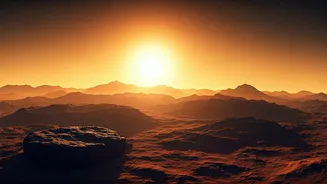
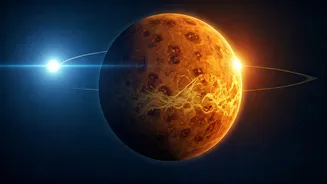
Here’s where it gets even stranger. While a rotational day is 243 Earth days, a solar day on Venus—the time from one sunrise to the next—is different. Because the planet is slowly spinning backward while orbiting the sun, a single solar day on Venus lasts about 117 Earth days. This means you’d experience about two sunrises and two sunsets for every Venusian year. Imagine a 'morning' that lasts for nearly two months, followed by an equally long 'night'. This slow cycle has profound implications for the planet’s climate. There's no quick dawn or dusk; just a protracted, scorching day followed by a long, equally hot night.
No Seasons, Just Extreme Heat
The headline's mention of 'seasons' is another area where Venus deviates wildly from the norm. Earth has distinct seasons because our planet is tilted on its axis by about 23.5 degrees. This tilt means different parts of the planet receive more direct sunlight throughout the year. Venus, however, has an axial tilt of only 3 degrees. This near-vertical alignment means it has no discernible seasons. The climate is monotonous and brutal year-round, everywhere on the planet. Its infamous, runaway greenhouse effect traps heat beneath a dense blanket of carbon dioxide and clouds of sulfuric acid, keeping surface temperatures at a staggering 465°C. The slow rotation might suggest a cold night side, but the thick atmosphere is incredibly efficient at circulating heat, ensuring the entire planet remains a furnace, day or night.
A Lesson in Planetary Diversity
Studying Venus is like looking at a funhouse mirror version of Earth. It’s a terrestrial, rocky planet of a similar size, but its evolutionary path took a dramatically different turn. The relationship between its spin and its orbit is a powerful reminder of how planetary mechanics can create wildly different worlds. Our familiar rhythm of a 24-hour day and a 365-day year, which has shaped all life and civilization on Earth, is not a universal constant. Venus shows us that the universe is full of possibilities, many of them far stranger than we could imagine, where the simple act of a planet spinning can create a reality that defies our earthly intuition.