




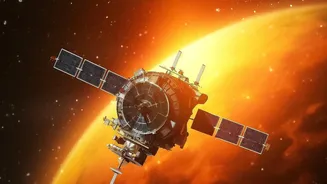


The Sun’s Violent Outbursts
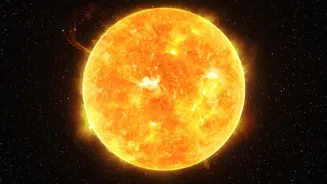
The primary threat comes from something called a coronal mass ejection, or CME. A CME is a massive, explosive eruption from the sun's outer atmosphere, the corona. It blasts enormous clouds of plasma—primarily electrons and protons—and tangled magnetic
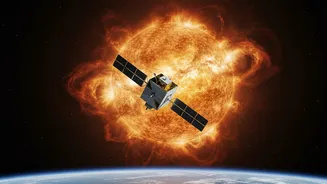
fields into space at speeds that can exceed thousands of kilometers per second. While the idea of a physical blast is dramatic, the real danger to satellites isn't the initial explosion itself. It's the wave of high-energy particles that follows. These particles, accelerated by the CME's shockwave, form a dangerous radiation storm that can engulf any object in its path, including our planet and the thousands of satellites orbiting it.
Satellites Under Digital Siege
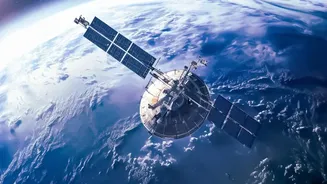
When this shower of high-energy particles hits a satellite, it can wreak havoc on its sensitive electronics. The effects range from temporary glitches to complete mission failure. Engineers categorize these impacts into several types, including single-event effects (SEEs) and total ionizing dose (TID) degradation. A SEE, often called a 'bit flip,' happens when a single particle strikes a memory cell, changing a 0 to a 1 or vice versa. This can corrupt data or cause the software to crash. More severe SEEs can cause a 'latch-up,' creating a short circuit that can lead to permanent damage if not quickly corrected. Total dose effects, on the other hand, are cumulative, as long-term exposure to radiation gradually degrades the performance of electronic components, shortening the satellite's operational lifespan.
The Digital Crystal Ball
Engineers can't simply launch test satellites into the path of a CME to see what happens. The cost and risk would be astronomical. Instead, they turn to sophisticated computer simulations. These digital models act as a virtual testing ground, allowing engineers to predict the effects of a solar storm without ever leaving Earth. The process starts by simulating the CME itself—modeling its size, speed, and trajectory based on data from solar observatories. More advanced models then simulate how the storm of energetic particles will travel through space and, most importantly, how those particles will interact with the specific materials and components of a satellite. These simulations can model the particle bombardment down to the level of individual microchips.
From Code to Radiation-Hardened Circuits
The results from these simulations are the blueprint for building tougher satellites. This practice, known as radiation hardening, involves a multi-layered defense strategy. If a simulation shows that a particular circuit board is highly vulnerable, engineers can implement several solutions. They might add physical shielding, using thin layers of dense materials like tantalum to block incoming particles. They could also select specialized, radiation-hardened electronic components, which are designed from the ground up to be more resilient. Another common strategy is building in redundancy; if one circuit is likely to fail, a backup can take over. Software plays a role too, with error-correcting codes designed to automatically detect and fix the 'bit flips' caused by radiation.
Building a Digital Fortress in Orbit
A radiation-resistant satellite architecture is more than just a collection of tough parts; it's a holistic design philosophy. The goal is to create a 'digital fortress' in orbit. This might involve placing the most critical electronics inside a heavily shielded 'vault' within the satellite's core. It also means meticulous layout of circuits to minimize interference and careful grounding practices to prevent charge from building up on surfaces. By using simulations to identify weak points before a single piece of hardware is built, companies can balance the need for protection against the immense cost and weight constraints of launching anything into space. It's a trade-off between overkill and unacceptable risk, and simulation is the key to finding the right balance.