



Beyond Mars: A New Cosmic Journey
The UAE Space Agency has formally embarked on its next great adventure, the Emirates Mission to the Asteroid Belt (EMA). Building on the success and experience gained from the Hope probe, which has been orbiting Mars since 2021, this new project represents
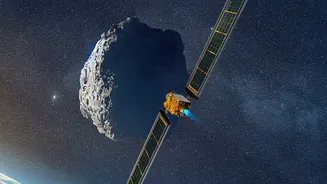
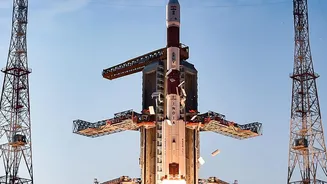
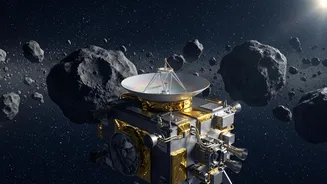
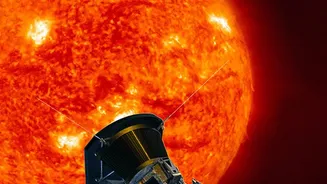
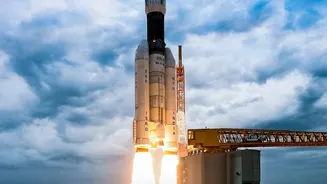
a major leap in the nation's space-faring capabilities. The mission involves sending a state-of-the-art spacecraft, named the MBR Explorer, on a 5-billion-kilometre journey to conduct a 'grand tour' of the main asteroid belt located between Mars and Jupiter. The launch is planned for a narrow three-week window in March 2028 from Japan. Mission planners have stressed that this launch window is critical, as the complex orbital mechanics involved won't align again for at least a century.
A 'Slingshot' Tour of the Solar System
The MBR Explorer's path is anything but a straight line. To reach its distant targets without carrying prohibitive amounts of fuel, the spacecraft will perform a series of gravity-assist manoeuvres. This cosmic billiard game will see it first fly by Venus in mid-2028, then swing past Earth in 2029. It will even use a flyby of Mars in 2031 to gain an additional gravitational push. These manoeuvres will build the velocity needed to enter the asteroid belt and begin its survey. Along the way, it will perform high-speed flybys of six different asteroids: Westerwald, Chimaera, Rockox, Ghaf, Ousha, and Moza. This phase alone will provide scientists with a wealth of comparative data on different types of space rocks before the main event.
The Scientific Prize: 269 Justitia
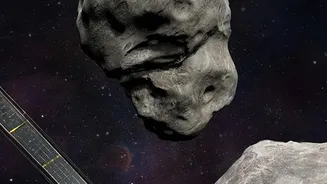
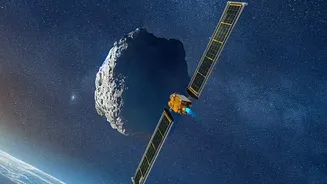
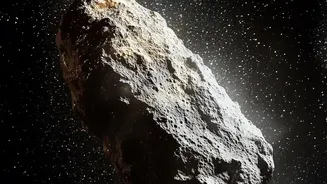
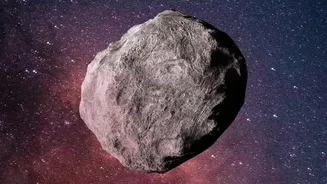
The ultimate destination, scheduled for a rendezvous in 2034, is the 54-kilometre-wide asteroid 269 Justitia. What makes it so special is its colour. Justitia is one of the reddest objects in the inner solar system, a feature far more common among bodies in the freezing outer reaches of the Kuiper Belt, beyond Neptune. This has led scientists to theorise that Justitia is a cosmic migrant—an object that formed in the frigid outer solar system and was somehow nudged inward billions of years ago. If this theory is correct, Justitia could be a 'shortcut' to studying the building blocks of our solar system. It may hold pristine water-related minerals and complex organic compounds that are typically only found on objects requiring decades-long missions to reach.
The Final Act: A Landing in Deep Space
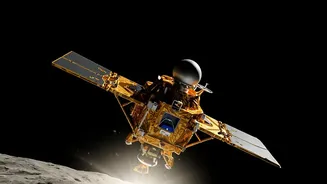
The mission's climax involves a maneuver of incredible precision. After spending approximately seven months orbiting and mapping Justitia, the MBR Explorer will deploy a small, autonomous lander. This probe, developed in Abu Dhabi by the Technology Innovation Institute, will descend to the surface, capturing images and data all the way down. Because of the immense distance, the lander must operate entirely on its own, without any real-time commands from Earth. The impact is expected to create a small crater, hopefully exposing subsurface material that has been shielded from the harsh space environment for eons. The final images sent back just before contact could be the most valuable of the entire mission, offering an unprecedented look at the composition of this mysterious red world.