



A New Guest in the Heavens
The first recorded sighting in Europe came from northern Italy on October 9, 1604. Soon, reports flooded in from across the continent and beyond. A 'guest star' had appeared in the constellation Ophiuchus, the serpent-bearer. At its peak, it was brighter
than Jupiter and every other star in the sky, visible even during the day for over three weeks. This stunning appearance, formally known as SN 1604, was a puzzle. To observers at the time, the heavens were supposed to be perfect and unchanging, a sphere of fixed stars as described by Aristotle. This new, temporary star suggested something entirely different: that the cosmos was a dynamic and evolving place.
Kepler's Meticulous Watch
Although he was not the first to see it—cloudy weather in Prague delayed his initial observation until October 17—the event would become synonymous with German astronomer Johannes Kepler. As the Imperial Mathematician, Kepler did what he did best: he observed, measured, and recorded. For an entire year, he meticulously tracked the star's position and its gradual fading from view. He performed all this work with his naked eye, as the telescope would not be turned to the heavens for another few years. In 1606, he published his findings in a book titled 'De Stella Nova in Pede Serpentarii' ('On the New Star in the Foot of the Serpent-Bearer'). It was this detailed, scientific account that cemented the event's legacy and ensured it would be forever known as Kepler's Supernova.
Global Eyes on a Global Event
While Kepler’s work was foundational in Europe, he was far from the supernova's only chronicler. Astronomers in Ming dynasty China recorded the 'guest star' beginning on October 10, just a day after the first Italian sighting. In Korea, royal astronomers also kept detailed and systematic records of the star's appearance and changes over many months. Records of the event also exist from Arabic sources. This global web of observations underscores the event's universal impact. From different corners of the Earth, people looked up and wondered about the same brilliant point of light, each contributing a piece to a puzzle that was larger than any single culture.
Shattering the Perfect Heavens
The appearance of SN 1604, and Tycho's Supernova 32 years earlier in 1572, delivered a powerful blow to the long-held Aristotelian model of the cosmos. That ancient view held that the realm beyond the Moon was eternal and immutable. A star simply appearing and then disappearing was a contradiction. Thinkers like Galileo Galilei in Italy used the event to argue that the 'new star' must be far beyond the Moon because it showed no parallax—the apparent shift in position when viewed from different locations on Earth. This conclusion, supported by the careful observations of Kepler and others, helped dismantle old dogmas and pave the way for a new, heliocentric understanding of the solar system and a more complex view of the universe.
What We Know Today
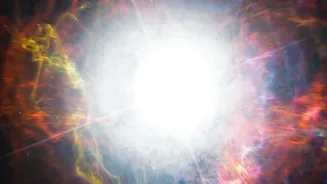
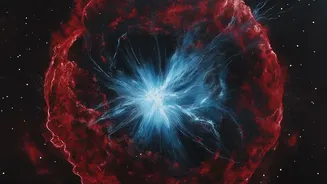
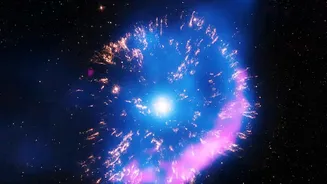
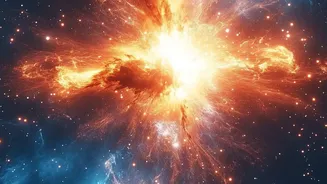
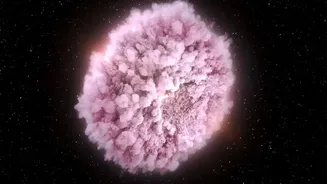
Today, we know that what Kepler and his contemporaries witnessed was not the birth of a star, but its violent death. SN 1604 was a Type Ia supernova, the thermonuclear explosion of a white dwarf star in a binary system, located approximately 20,000 light-years from Earth. As the last supernova to be definitively observed with the naked eye within our own Milky Way galaxy, it remains a crucial object of study. Modern telescopes can see the expanding shell of gas and dust—the supernova remnant—that was thrown out by the explosion. By studying this remnant in X-ray and radio light, astronomers learn about the life and death of stars and the creation of heavy elements that are essential for forming new stars and planets.