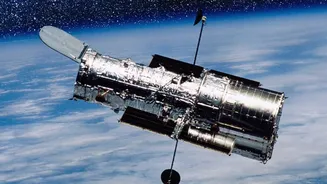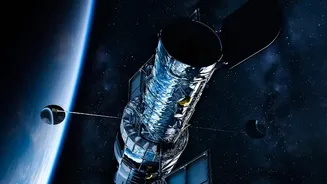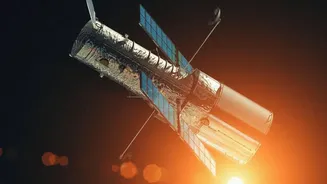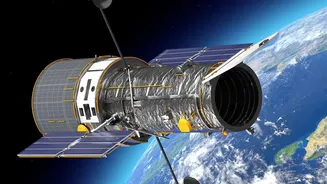






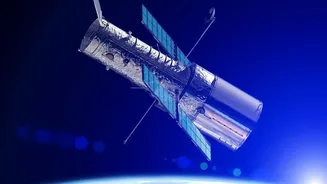
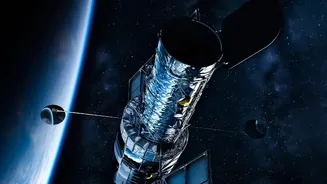
The legendary Hubble Space Telescope, our eye on the cosmos for over three decades, is slowly falling from the sky. To save the iconic observatory, NASA is turning to the private sector for a daring orbital rescue mission.
A Slow But Steady Descent
Since its launch in 1990, the
Hubble Space Telescope has orbited Earth, capturing images that have transformed our understanding of the universe. However, it has no propulsion system of its own. It orbits in low Earth orbit, where there is still a tenuous atmosphere. This creates a tiny amount of drag, which over decades has caused Hubble's orbit to decay. It has gradually sunk from its original altitude of around 600 kilometers to about 540 km. Without intervention, NASA projects the telescope could make an uncontrolled reentry into Earth's atmosphere sometime in the mid-2030s. This poses a small risk on the ground and would mean the end of a priceless scientific asset.
A New Call for a Commercial Lifeline
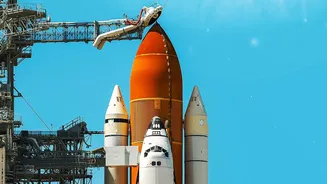
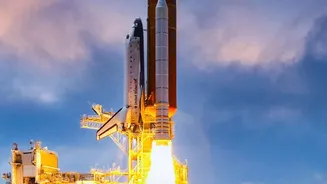
To prevent this, NASA has formally asked the commercial space industry for ideas. In late October 2026, the agency issued a 'Request for Information' (RFI), a kind of market research step. The RFI outlines three possibilities: a mission to boost Hubble into a higher, more stable orbit; a servicing mission to upgrade its systems; or a mission to safely guide it to a controlled deorbit over the ocean. This marks a significant shift, as previous servicing missions were conducted by government astronauts during the Space Shuttle era. With the shuttle retired, NASA is now looking at what its commercial partners can offer. The provider would be responsible for the rocket, the spacecraft, and all mission operations.
The Polaris Proposal and Other Concepts
This isn't the first time a commercial Hubble mission has been discussed. In 2022, NASA and SpaceX signed an agreement to study the feasibility of using a Dragon spacecraft to reboost the telescope. The study was proposed in partnership with the Polaris Program, a series of private spaceflights funded by billionaire Jared Isaacman. The idea was for a privately funded crewed mission to not only raise Hubble's orbit but potentially service it, all at little to no cost to the taxpayer. However, after initial studies, concerns were raised within NASA about the risks of a complex mission using unproven spacesuits and a spacecraft not originally designed for grappling with a telescope. The new RFI in 2026 reopens the door to the entire industry, soliciting both robotic and crewed concepts.
What Would a Rescue Mission Achieve?
The primary goal of a reboost mission would be to extend Hubble's operational life. Boosting the telescope back up to an altitude of 600 kilometers could add 15 to 20 years, or possibly more, to its lifespan. This would allow it to continue its scientific work, which remains highly valuable even with the success of the James Webb Space Telescope. The two telescopes have complementary capabilities, and using them in tandem enables greater scientific discovery than either could achieve alone. Beyond the science, a successful commercial mission would also prove a new model for in-space servicing, demonstrating that private companies can perform complex operations that were once the sole domain of national space agencies.
A Test Case for the Future of Space
While NASA has not yet committed any funding for a mission, the request for information is a crucial first step. Companies have until the end of November 2026 to submit their concepts, outlining their technical approach, costs, and timelines. Any potential mission would need to launch by 2032 to be effective. The response from the rapidly evolving commercial space sector—which now includes companies specializing in robotics and satellite servicing—will be telling. This effort is more than just about saving a single, albeit beloved, telescope. It represents a potential turning point where public–private partnerships become the standard for maintaining and extending the life of our most critical assets in orbit, paving the way for a more sustainable and dynamic future in space.