



The Cosmic Speed Limit
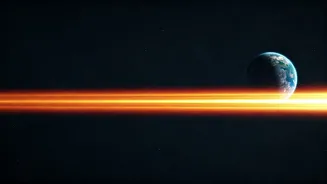
It sounds like a riddle, but it’s a fundamental truth of our universe. Light, while incredibly fast, is not instantaneous. It travels at a constant, blistering pace of approximately 3,00,000 kilometres per second. This is the universe's ultimate speed
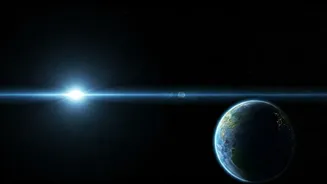
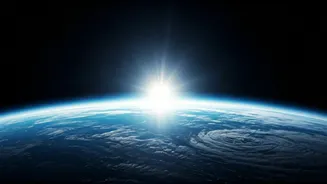
limit, a rule set by physics that nothing with mass can break. Now, consider the distance between its source—the Sun—and us. On average, Earth orbits the Sun at a distance of about 150 million kilometres. It's a number so vast it’s almost impossible to truly comprehend. But if we do the simple maths (distance divided by speed), we get the travel time. That 150-million-kilometre journey, even at the astonishing speed of light, takes approximately 8 minutes and 20 seconds. So, the light you see and feel at this very moment is not from the Sun as it is *now*, but from the Sun as it was over eight minutes ago. You are, in a very real sense, looking into the past.
An Even Longer Journey
The eight-minute trip across space is just the final, frantic leg of a much longer, more arduous journey. The particles of light, called photons, that warm your face today were born deep within the Sun's core. They are created through nuclear fusion, the same process that powers our star, where hydrogen atoms are crushed together under immense pressure and heat to form helium. But a photon’s life doesn't start with a straight shot out. The Sun's interior is incredibly dense—a chaotic plasma of charged particles. As soon as a photon is created, it gets absorbed by a nearby atom and then re-emitted in a random direction. It bounces from particle to particle in a journey scientists call a 'random walk'. This process can take a staggeringly long time. While estimates vary, it's believed a single photon can take anywhere from 10,000 to over 1,00,000 years just to travel from the Sun's core to its surface. The light hitting Earth today was created before the dawn of human civilisation.
What if the Sun Vanished?
This eight-minute delay has a profound and slightly unsettling implication. If the Sun were to magically and instantly disappear, we wouldn't know it for 8 minutes and 20 seconds. For that duration, the sky would remain bright, the Earth would continue its orbit, and we would feel the Sun's warmth, completely oblivious to the fact that our star was already gone. It's a powerful reminder that our perception of 'now' is not the same as the universe's 'now'. This isn't just theoretical. When astronomers observe celestial events, they are always accounting for this time lag. The information we receive—whether it's the light from a supernova or the gravitational waves from colliding black holes—is always old news, a postcard from a distant past delivered to us at the cosmic speed limit.
A Universe of Time Travellers
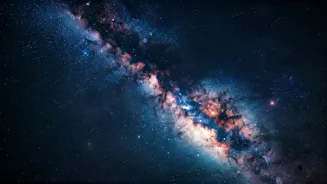
Our Sun is just the beginning. This principle of light-speed delay means that every time we look up at the night sky, we are looking back in time. The closest star system to us, Alpha Centauri, is about 4.3 light-years away. The light we see from it tonight left those stars over four years ago. The light from the stars forming the Big Dipper ranges from 60 to over 120 years old. And the farther we look, the deeper into the past we peer. The Andromeda Galaxy, the most distant object visible to the naked eye, is 2.5 million light-years away. The light you might glimpse from it on a clear night began its journey when our earliest human ancestors were first walking the Earth. Telescopes like the James Webb Space Telescope are designed to be powerful time machines, capturing light from the very first galaxies that formed over 13 billion years ago. The eight-minute delay from our Sun is simply our most immediate and personal connection to this universal truth.