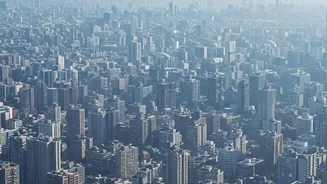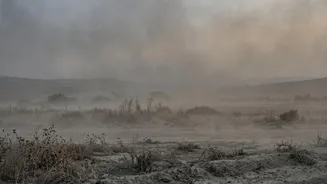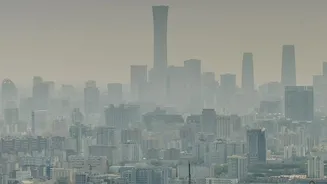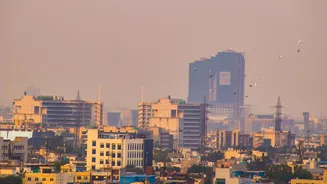






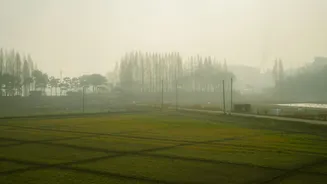
As winter approaches in North India, the air quality map turns red. News reports throw around terms like PM2.5 and PM10, but what do they really mean? Let's break down the science behind these pollutants and see what they tell us about the air.
What Is Particulate Matter?
Before
diving into the numbers, let's start with the basics. 'PM' stands for Particulate Matter, a complex mix of solid particles and liquid droplets floating in the air. Think of it as a cocktail of dust, soot, smoke, and other tiny fragments. These particles are too small to see with the naked eye, but they are what create the familiar haze that blankets cities. They are categorised by size, measured in micrometres (or microns). For context, a single human hair is about 50-70 micrometres wide. The two most commonly discussed categories are PM10 and the much finer PM2.5.
Meet PM10: The Coarser Particles
PM10 refers to inhalable particles with a diameter of 10 micrometres or less. These are the 'coarser' particles. Their sources are often mechanical, such as dust kicked up from construction sites, landfills, and agriculture, as well as road dust from tyre and brake wear. Natural sources include pollen and mold spores. When you breathe in PM10, your body’s natural defences in the nose and throat can trap many of these larger particles. However, they can still irritate your eyes, nose, and throat, and for those with respiratory conditions like asthma, they can trigger attacks and worsen symptoms.
Meet PM2.5: The Invisible Danger
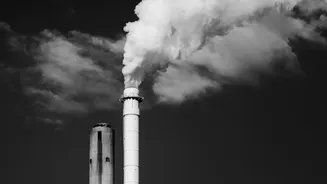
PM2.5 refers to fine particles with a diameter of 2.5 micrometres or less—about 30 times smaller than the width of a human hair. These particles are so tiny they behave more like a gas. Their primary sources are combustion processes: vehicle exhaust (especially from diesel engines), industrial emissions, wood burning, and, significantly for North India, stubble burning. Because they are so small and light, they can stay in the air for days and travel hundreds of kilometres from their source.
Why Smaller Is So Much More Harmful
The critical difference between the two pollutants is how they affect the human body. While PM10 particles are largely caught in the upper airways, PM2.5 particles are small enough to bypass these defences and travel deep into the lungs. From there, the most minuscule particles can even pass into the bloodstream, allowing them to reach and affect other organs, including the heart and brain. This is why long-term exposure to PM2.5 is linked to a much wider range of severe health problems, including chronic respiratory diseases, heart attacks, strokes, diabetes, and even premature death. For this reason, health experts consider PM2.5 the more significant public health threat.
A Tale of Two Cities: Bikaner and Bathinda
Recent air quality readings from early November highlight the regional nature of this crisis. On November 4, 2026, Bikaner in Rajasthan reportedly recorded an astronomical Air Quality Index (AQI) of 1,357, making it the most polluted city in the country at that time. On the same day, Bathinda in Punjab was not far behind, with an AQI of 883. Specifically, on November 4, Bathinda's air was laden with PM2.5 measuring 463 µg/m³ and PM10 at 556 µg/m³. The extremely high levels in Bathinda are often linked to extensive stubble burning in the region. Bikaner's pollution, while also severe, can be influenced by a combination of factors, including dust from the arid landscape and cross_regional smoke drift. These staggering numbers, far exceeding the 'Hazardous' threshold, show that the pollution crisis is a widespread issue across North India, not just confined to one or two major metros.