



The Man at the Centre of the Mission
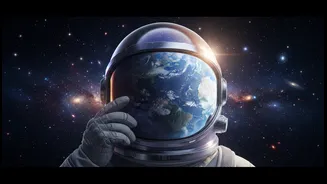
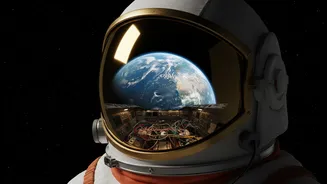
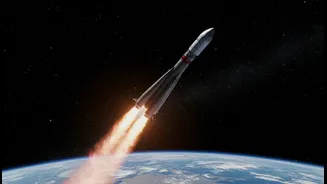
On July 14, when the Russian Soyuz MS-29 rocket lifts off from the Baikonur Cosmodrome, one of its three passengers will be NASA astronaut Anil Menon, who is of Indian origin. It will be the first spaceflight for Menon, who was selected for NASA's astronaut corps
in 2021 and will spend approximately eight months aboard the International Space Station (ISS) as a flight engineer for Expedition 74/75. Born in Minneapolis to an Indian father and a Ukrainian mother, Menon's journey to the stars is a remarkable one. The 49-year-old is an emergency medicine physician and a decorated colonel in the US Space Force. His career has spanned serving on the frontlines in Afghanistan, working as the first flight surgeon for SpaceX, and even spending a year in India as a Rotary Ambassadorial Scholar to support polio vaccination efforts. His diverse experience makes him uniquely suited for the rigours of space.
A Symbol of Cooperation in Orbit
Menon’s flight is a powerful symbol of the enduring international cooperation that defines the ISS. He will launch on a Russian spacecraft alongside Roscosmos cosmonauts Pyotr Dubrov and Anna Kikina, highlighting a partnership between NASA and its Russian counterpart that continues despite geopolitical tensions on Earth. This seat-swapping arrangement ensures that both American and Russian crew members have continuous access to the station, providing critical redundancy for safe operations. In an era of global friction, the image of an American astronaut with Indian and Ukrainian heritage launching on a Russian rocket to work on a collaborative global project serves as a potent reminder of space as a unifying frontier. The ISS itself, which has been continuously inhabited since November 2000, remains a testament to this collaborative spirit, with operations currently planned to continue through at least 2028.
The Science of Living in Space
Beyond the symbolic significance, Menon’s eight-month mission is packed with critical scientific research aimed at enabling future long-duration missions to the Moon and Mars. As a physician, much of his work will focus on human physiology. He is scheduled to conduct experiments studying the effects of microgravity on astronauts' vein structure, blood flow, and blood composition. Another crucial experiment involves testing methods to produce intravenous (IV) fluids using the space station's own potable water system, a technology that could be life-saving on deep-space journeys where resupply is impossible. Menon will also contribute to research on the in-space production of semiconductor crystals, which could lead to breakthroughs in high-performance computing and medical devices back on Earth.
Context for India's Own Giant Leap
Anil Menon’s journey into orbit comes at a pivotal time for India's own space ambitions. As the nation watches an astronaut of Indian heritage fly to the ISS, the Indian Space Research Organisation (ISRO) is making significant strides with its own human spaceflight programme, Gaganyaan. In early July 2026, ISRO successfully conducted crucial tests of the parachute system designed to bring the Gaganyaan crew module safely back to Earth. These tests are a vital step toward the first uncrewed Gaganyaan mission, which will validate the systems before Indian astronauts, or 'Vyomanauts', are launched into orbit. Menon's flight provides an inspiring touchpoint and a real-time example of the complexities and rewards of human spaceflight, offering a preview of the journey India is preparing to undertake itself. While Menon joins a list of celebrated astronauts with Indian roots, the success of the Gaganyaan program will soon see India become only the fourth nation to launch its own crewed spacecraft.