





An Ocean World Full of Promise
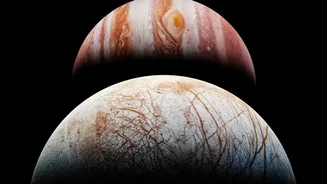
For decades, scientists have gathered tantalizing clues about Europa. Data from missions like Galileo strongly suggested the presence of a global ocean of salty liquid water hidden beneath an icy crust. This ocean is estimated to contain more than twice
the amount of water found in all of Earth's oceans combined. The essential ingredients for life as we know it—water, chemistry, and energy—are all thought to exist there. The water is present in the ocean, the necessary chemical elements may be supplied by the moon's rocky seafloor, and energy could come from the constant tidal flexing caused by Jupiter's immense gravity. This makes Europa one of the most compelling places in our solar system to search for habitable environments beyond our own planet.
A Cosmic Detective on a Long Journey
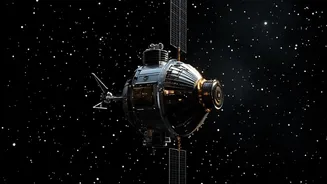
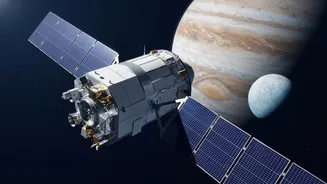
The Europa Clipper spacecraft is one of the largest interplanetary probes ever built by NASA, with solar arrays that span the length of a basketball court. Launched in October 2024, it has a long road ahead, scheduled to arrive in the Jupiter system in April 2030 after a 2.9-billion-kilometre journey. Instead of orbiting Europa directly, which would expose it to Jupiter’s intense and damaging radiation, Clipper will make a series of nearly 50 close flybys. This clever orbit allows the spacecraft to dip in for brief, intense periods of data collection, with altitudes dropping as low as 25 kilometers, before retreating to the relative safety of a wider orbit around Jupiter. This strategy protects its sensitive suite of nine science instruments, which are further shielded inside a robust aluminum-titanium vault.
Peering Beneath the Miles of Ice
One of Clipper's key tools is an ice-penetrating radar instrument called REASON, short for Radar for Europa Assessment and Sounding: Ocean to Near-surface. It is the only instrument that can look directly through the moon's thick ice shell. REASON works by transmitting radio waves that can penetrate up to 30 kilometers deep into the ice. By analyzing the reflected signals, scientists will be able to map the thickness of the ice shell, search for the boundary where ice meets the liquid ocean, and even identify potential pockets of water trapped within the shell, similar to subsurface lakes found beneath Antarctica's glaciers. This will provide the first three-dimensional view of Europa's icy exterior, revealing its structure and history.
Sniffing for the Ingredients of Life
To analyze Europa's chemistry, Clipper carries powerful mass spectrometers, including MASPEX (MAss SPectrometer for Planetary EXploration) and SUDA (SUrface Dust Analyzer). These instruments will 'taste' or 'sniff' the molecules in Europa's extremely thin atmosphere and any water vapor plumes that may be erupting into space from the ocean below. As the spacecraft flies through these gases, the instruments will capture them, ionize them (give them an electric charge), and then measure their mass with incredible precision. This process allows scientists to identify the exact chemical composition of the material, searching for organic compounds and other elements that could signal a habitable environment. It’s a way of sampling the ocean without ever having to touch it.
Searching for Habitability, Not Aliens
It is important to understand that Europa Clipper is not designed to find life itself. Instead, its main scientific goal is to determine if Europa has the right conditions to support life. The mission is focused on confirming the presence and characteristics of the ocean, understanding the geology of the surface, and cataloging the chemical inventory available. By studying the three key requirements—water, chemistry, and energy—Clipper will provide a detailed assessment of Europa's potential habitability. The findings will be crucial for guiding future missions, which could one day include a lander designed to search for direct evidence of life in this distant, icy world.