



More Than a Pretty Picture
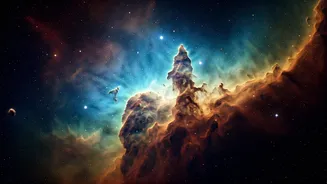
Consider the iconic 'Pillars of Creation,' a small region within the vast Eagle Nebula, roughly 6,500 light-years away. First made famous by the Hubble Space Telescope, this celestial landmark was given a spectacular update by the JWST. While Hubble’s
view showed dark, formidable structures, Webb’s infrared gaze pierces through the obscuring dust, transforming the pillars into a semi-transparent landscape teeming with activity. These majestic formations are not solid rock but are composed of cool interstellar gas and dust—the very raw materials for building stars. Looking at Webb’s version is like putting on a pair of glasses that allows us to read a hidden language written in light and dust.
A Stellar Nursery Revealed
The main story of the Pillars of Creation is star birth. Within these dense columns of gas and dust, gravity is pulling material together into knots. As these knots accumulate enough mass, they begin to collapse and heat up, eventually igniting to form new stars. What makes Webb’s view so revolutionary is its ability to see these newborn stars for the first time. Bright red orbs, some with distinct diffraction spikes, are young stars that have just emerged from their dusty cocoons. Many are estimated to be only a few hundred thousand years old—infants on a cosmic timescale. Webb's unparalleled clarity allows scientists to get a much more accurate count of these newly formed stars, helping them refine their models of star formation.
Seeing the Invisible
One of the key lessons from Webb’s images comes from its ability to see in infrared light. Visible light, which our eyes and telescopes like Hubble primarily see, cannot penetrate the thick dust of the pillars. But infrared light, which is essentially heat radiation, can. This allows Webb to peer inside the dusty columns and detect the protostars that are still forming. You can spot these as bright red dots, particularly at the tips of the pillars. Some of the most dramatic details are the wavy, lava-like lines at the edges of the columns. These are supersonic jets of material being ejected by stars as they form, colliding with the surrounding gas and dust and causing them to glow. This crimson glow is evidence of the energetic, chaotic process of stellar birth in action.
The Language of Light and Colour
The different colours in Webb’s images are not just for aesthetics; they are a form of data visualization. Webb is equipped with multiple instruments, like the Near-Infrared Camera (NIRCam) and the Mid-Infrared Instrument (MIRI), each sensitive to different wavelengths of light. NIRCam is excellent at imaging stars, which shine brightly in near-infrared. MIRI, on the other hand, excels at highlighting dust, which glows in mid-infrared wavelengths. By combining these views, astronomers can distinguish between stars and the dusty environments they inhabit. For example, in a mid-infrared view, the stars seem to recede, and the pillars of dust become the ghostly, dominant feature. This ability to dissect the image by wavelength gives scientists a comprehensive understanding of the interplay between gas, dust, and stars.