







The Challenge of a Safe Return
Sending astronauts into orbit is only half the mission. Bringing them home safely is arguably the more complex challenge. After its journey in space, the Gaganyaan crew module will re-enter Earth's atmosphere at hypersonic speeds, generating immense heat.
Once through the most intense phase of reentry, the capsule is still moving too fast for a safe landing. It needs to slow down from hundreds of kilometres per hour to a gentle splashdown speed. This is where the parachute deceleration system comes in, acting as the final, crucial brake for the multi-ton module. It is one of the most vital safety features of the entire mission, with no room for error.
A Ten-Parachute Symphony
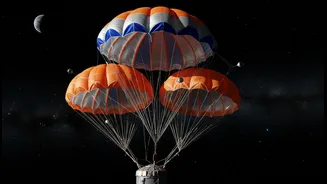
The Gaganyaan's deceleration system is not just one parachute but a precisely choreographed sequence involving 10 parachutes of four different types. The sequence begins after the intense heat of reentry, when two Apex Cover Separation parachutes deploy to jettison the protective cover of the parachute compartment. Next, two Drogue parachutes are deployed. These smaller, robust chutes are designed to stabilise the module at high speed, preventing it from tumbling and providing the initial, significant reduction in velocity. This stabilisation is critical for the next stage to work flawlessly.
From Drogues to Mains
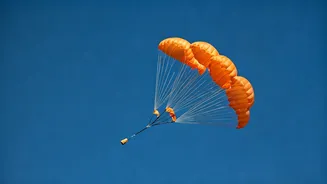
Once the Drogue parachutes have done their job and the capsule is stable, the main event begins. Three small Pilot parachutes are deployed, each responsible for pulling out one of the three large Main parachutes. This multi-parachute design provides crucial redundancy; even if one of the main parachutes fails to open, the remaining two are sufficient to ensure a safe landing speed. To prevent the enormous canopies from tearing themselves apart upon opening, they use a technique called 'reefing,' where lines initially keep the parachutes partially closed, allowing them to inflate more gently before being cut to allow full inflation. This complex, automated sequence transforms a plummet into a controlled descent.
Rigorous Real-World Testing
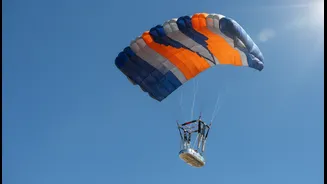
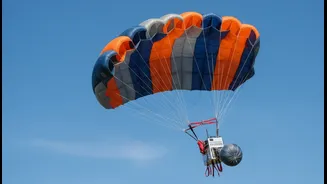
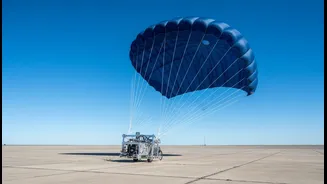
To ensure this system is flawless, the Indian Space Research Organisation (ISRO), in collaboration with DRDO, the Indian Air Force, and the Indian Army, has been conducting a series of exhaustive tests. In recent Integrated Main Parachute Airdrop Tests (IMAT), a dummy mass equivalent to the crew module was dropped from an Indian Air Force IL-76 aircraft from an altitude of 2.5 km to simulate the descent. These tests, conducted at the ADRDE drop zone in Madhya Pradesh, validate the structural integrity and performance of the parachutes under expected load conditions. Successful completion of these tests provides the confidence needed to proceed with the first uncrewed Gaganyaan (G1) mission.
The Final Splashdown
The entire parachute deployment sequence is designed to achieve one ultimate goal: slowing the crew module to a speed of less than 11 metres per second for a gentle splashdown in the ocean. The choice of a water landing is deliberate, as the sea acts as a natural cushion, absorbing the final impact energy. Naval recovery teams, who have also been conducting extensive drills with mock capsules, will then be on hand to retrieve the module and its precious human cargo. Every successful test of the parachute system is a critical step, bringing India closer to the historic moment when it will launch its own astronauts into orbit and, most importantly, bring them safely back home.