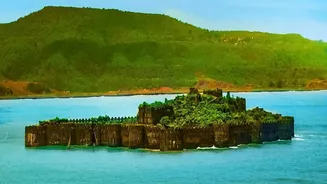






Lining Maharashtra’s Konkan coast are silent sentinels of stone, but none tell a story as dramatic as Murud-Janjira. Rising from the Arabian Sea, this island fortress is a monument to defiance, ingenuity, and a forgotten coastal dynasty.
An Impregnable Island Fortress
Located on an
oval-shaped rock off the coast of Murud village in Raigad district, Murud-Janjira Fort is a testament to incredible military engineering. For nearly 500 years, it stood as one of India's most formidable coastal strongholds. Its reputation is built on a singular, staggering fact: it was never conquered. Despite relentless sieges by the powerful Marathas under Chhatrapati Shivaji Maharaj, and repeated attacks by the Portuguese, British, and Mughals, the fort's defenses never fell. This unparalleled record earned it the moniker 'the unconquerable fort', a legacy etched into every stone that has weathered the sea and storms for centuries.
The Rise of the Sidis
The story of Janjira is inseparable from its rulers, the Sidis. Originally of African descent, specifically from Abyssinia (modern-day Ethiopia), the Sidis arrived in India as early as the 7th century, often as merchants, sailors, or soldiers. Over time, their military and naval prowess saw them rise to positions of power in the Deccan Sultanates. The fort itself began as a small wooden structure built by local Koli fishermen in the 15th century to defend against pirates. It was later captured and transformed into a mighty stone fortress in the late 16th century under figures like Malik Ambar, an Abyssinian regent of the Ahmadnagar Sultanate. From this base, the Sidis established an autonomous state that would dominate this stretch of the Konkan coast for generations, ruling from their island capital until India's independence.
A Masterpiece of Defensive Architecture
Janjira's invincibility was no accident; it was the result of brilliant strategic design. Its 40-foot-high granite walls rise directly from the sea, making a frontal assault nearly impossible. The main gate is ingeniously concealed and only becomes visible when an approaching boat is within a few dozen feet, a feature designed to confuse and disorient attackers. The fort is ringed by 19 imposing, rounded bastions, which once mounted over 500 cannons. Three of these massive cannons—Kalaal Baangadi, Chavri, and Landa Kasam—were particularly feared for their range and destructive power. Adding to its self-sufficiency, the fort astonishingly contains two natural freshwater lakes and a deep well, ensuring a permanent water supply for its inhabitants despite being surrounded by the salty Arabian Sea.
Inside the Walls
In its prime, Janjira was not just a military outpost but a self-contained township. Within its 22ndndnd acre expanse, the ruins of palaces, officers' quarters, a mosque, and granaries offer a glimpse into the life that once thrived here. The 'Palace of the Nawab' stands as a reminder of the Sidis' royal court. A striking stone carving near the main entrance depicts a tiger-like creature clutching six elephants in its claws, a powerful symbol believed to represent the Sidis' might over their adversaries. Though now in ruins, exploring these structures feels like walking through a living history book, with every archway and crumbling wall echoing with tales of royal intrigue and battlefield glory.
Visiting Janjira Today
Today, Murud-Janjira is a major tourist destination, drawing visitors who come to marvel at its history and resilience. Reaching the fort involves a short but thrilling journey on small sailboats from the Rajapuri jetty near Murud. The best time to visit is between October and March, when the sea is calm and the weather is pleasant for exploring. The fort typically remains closed during the monsoon season (June to September) due to rough seas. As you step onto the ancient stones, you're not just entering a monument; you're experiencing a piece of India's rich and complex maritime heritage, a story of survival and power that continues to captivate all who hear it.