



A Familiar Galaxy in a New Light
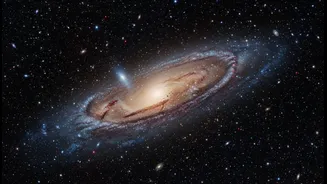
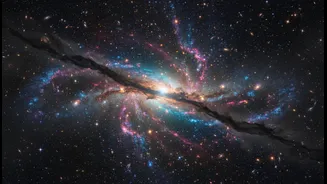
For decades, astronomers have studied Centaurus A, one of the most brilliant and unusual objects in the southern sky. In standard telescopes, it appears as a bright elliptical galaxy sliced in half by a thick, dark lane of cosmic dust. This striking feature
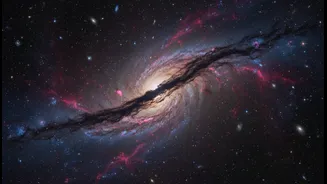
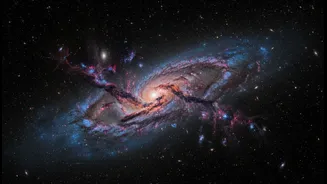
hinted at a violent past, but the full story was shrouded in mystery. The dust was like a curtain, blocking our view of the galaxy's core. Now, thanks to the powerful infrared capabilities of observatories like the James Webb Space Telescope (JWST), that curtain has been drawn back. These new images reveal the galaxy not as a serene oval, but as a complex and dynamic system shaped by cataclysmic events.
The Power of Seeing the Invisible
Why is infrared light the key to unlocking these secrets? Unlike visible light, which is easily blocked by cosmic dust, infrared wavelengths can pass through these obscuring clouds. This allows astronomers to see what lies behind them. It’s the cosmic equivalent of using an X-ray to see bones through skin. In the case of Centaurus A, JWST's Mid-Infrared Instrument (MIRI) and Near-Infrared Camera (NIRCam) have pierced the dust to uncover glowing filaments, loops, and previously hidden structures at the galaxy's heart. What once appeared as a dark slash is now a richly textured band of golden-orange dust, with knots and mottled patches that tell a story of cosmic turmoil.
Unveiling the Galactic Engine
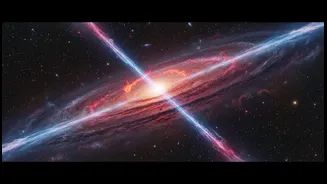
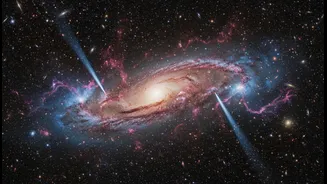
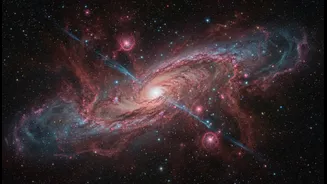
At the very center of Centaurus A lies a supermassive black hole, about 55 million times the mass of our sun. This black hole is not dormant; it is actively feeding on surrounding gas and dust. As it consumes material, it unleashes colossal jets of high-energy particles that travel at nearly the speed of light, stretching for thousands, and in radio wavelengths, millions of light-years into space. While these jets have been observed before in X-ray and radio light, the new infrared images show their impact on the galaxy in stunning detail. The images reveal how this powerful engine is sculpting its environment, pushing around gas and dust and influencing the entire galactic structure. A mysterious S-shaped structure near the core, now visible in infrared, may be a direct result of this ongoing activity or the galaxy's ancient collision.
A Story Written in the Stars
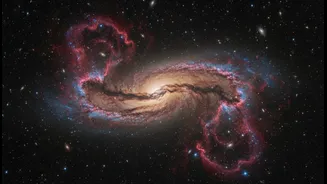
The dramatic appearance of Centaurus A is the result of a galactic merger that occurred roughly two billion years ago, when a large elliptical galaxy collided with a smaller spiral galaxy. The warped disk of gas and dust we see today is the remnant of that cosmic crash. Infrared imaging does more than just show the dust; it reveals the stars within it. While older telescopes saw a blurry glow, JWST can resolve millions of individual stars, allowing astronomers to distinguish between different generations. This is a form of galactic archaeology. By studying the ages and distribution of these stars, scientists can reconstruct the timeline of the merger and understand how such events trigger furious bursts of new star formation. The infrared view shows precisely where these stellar nurseries are hidden within the dusty lanes.