



Let’s Redefine a 'Day'
Before we travel to Venus, let’s get our terms straight right here on Earth. We actually have two kinds of 'days'. The first is the 'solar day', which is the 24 hours it takes for the Sun to return to the same position in the sky. This is what we live
by. The second is the 'sidereal day', which is the time it takes for Earth to complete one full 360-degree rotation on its axis. This is slightly shorter, at about 23 hours and 56 minutes. The small difference is because Earth is also moving along its orbit around the Sun. This distinction is usually a fun trivia fact on Earth, but on Venus, it’s the key to understanding its mind-bending timekeeping.
Venus: The Slow, Backward Spinner
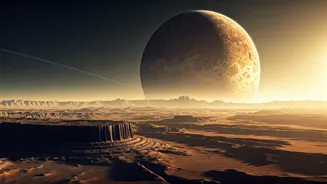
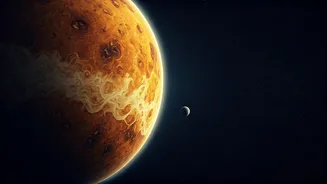
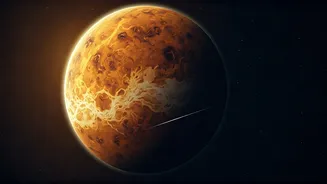
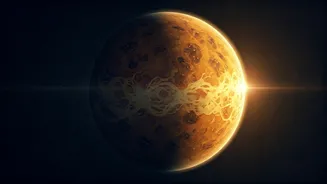
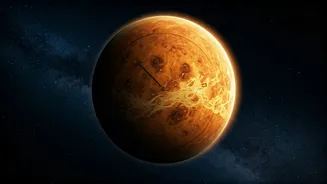
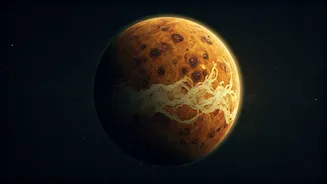
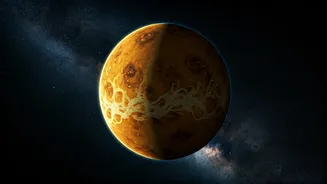
Now, let’s look at Venus. It is an outlier in our solar system for two major reasons. First, it spins incredibly slowly. While Earth whips around on its axis in under 24 hours, Venus takes a staggering 243 Earth days to complete a single rotation. That’s the core 'planetary metric' from the headline. One full spin on Venus takes longer than it takes Earth to complete two-thirds of its journey around the Sun. Second, Venus spins backward. This is known as retrograde rotation. Nearly every other planet in our solar system, including Earth, spins counter-clockwise on its axis. Venus spins clockwise. If you could stand on its surface, you would see the Sun rise in the west and set in the east.
A Day That Lasts Longer Than a Year
Here is where things get truly weird. A year on Venus—the time it takes to complete one orbit around the Sun—is about 225 Earth days. But as we just learned, its sidereal day—one full rotation on its axis—is 243 Earth days. This means a single day of rotation on Venus is longer than its entire year. Imagine celebrating your birthday before the planet you’re on has even finished spinning once. This is the bizarre reality for our planetary neighbour. No other planet in our solar system has a day that outlasts its year. This single fact completely warps our Earth-centric understanding of time.
The Sunrise-to-Sunrise Cycle
So, if one rotation takes 243 Earth days, does that mean you’d have to wait that long for the Sun to rise again? Not quite. This is where the retrograde (backward) spin and the solar day come into play. Because Venus is rotating backward while it orbits the Sun, the two motions work against each other in a unique way. The effect is that the time from one sunrise to the next (its solar day) is significantly 'shorter' than its rotational period. A solar day on Venus is about 117 Earth days long. So, you’d experience roughly two sunrises and sunsets for every Venusian year. It’s still an incredibly long time to wait for morning, but it’s a crucial distinction that makes Venusian timekeeping even more fascinating.
Why Is Venus So Strange?
Scientists are still piecing together the puzzle of Venus's peculiar rotation. The leading theory involves its punishingly thick atmosphere. The Venusian atmosphere is about 90 times denser than Earth’s and whips around the planet at incredible speeds in a phenomenon known as 'super-rotation'. This heavy, fast-moving blanket of gas is thought to exert a significant amount of friction and tidal torque on the planet's surface, acting like a brake and slowing its spin over billions of years. Another theory suggests that a massive collision with another planetary body deep in its past could have knocked it off-kilter, reversing its spin and drastically slowing it down. It’s likely a combination of these ancient and ongoing forces that made Venus the temporal oddity it is today.