



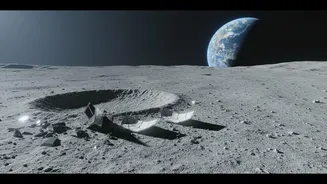
The 5 August 'Moon Impact': A Case of Mistaken Identity
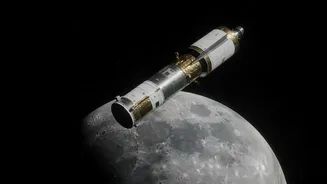
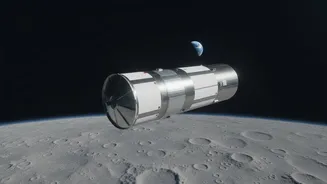
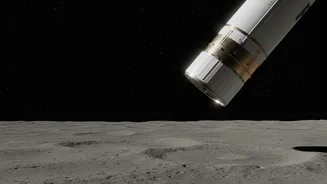
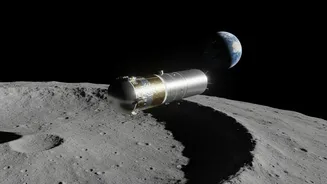
First, the good news: the Moon is not in danger from a rogue asteroid today. The much-discussed 'impact' on August 5, 2026, is actually a predictable event involving man-made space junk. An upper stage from a SpaceX Falcon 9 rocket, which completed its
mission in 2025, is expected to collide with the lunar surface. While scientifically interesting, this event poses no danger. This incident, however, is a perfect opportunity to understand how scientists distinguish between predictable debris, genuine near-misses, and the overblown hype that often circulates online.
The Real Detectives: How We Track Near-Earth Objects
Planetary defense isn't left to chance. Scientists use a global network of ground-based telescopes to scan the skies for Near-Earth Objects (NEOs), which are asteroids and comets whose orbits bring them close to Earth. When a new object is spotted, its position is measured against background stars to calculate a preliminary orbit. This initial data can be uncertain. To refine it, organizations like NASA's Center for Near-Earth Object Studies (CNEOS) use automated systems, such as Sentry-II, to constantly monitor these objects, recalculate their paths with every new observation, and project their movements for the next 100 years. The goal is to create a comprehensive catalog of potential threats long before they become an actual problem.
From 'Might Hit' to 'Will Miss': The Science of Probability
Why do predictions seem to change so often? When an asteroid is first discovered, there's very little data, leading to a wide range of possible future paths—some of which might intersect with Earth. As more observations are made over days and weeks, the object's trajectory becomes clearer, and the 'cloud' of uncertainty shrinks. This is why an asteroid might initially be flagged as a potential risk, only to have that risk downgraded to zero later. It doesn't mean the first calculation was wrong; it just means the prediction got more precise with better data. This process is a sign that the system is working as intended.
The Torino Scale: A 'Richter Scale' for Asteroids
To communicate risk without causing undue panic, scientists use the Torino Scale. It's a 0-to-10 rating that combines the probability of an impact with its potential destructive power. A '0' means an object has a negligible chance of impact or is too small to cause damage. A '10' signifies a certain collision with catastrophic global consequences. Most new discoveries start and end at 0. Occasionally, an object might briefly climb to a 1, 2, or 3, indicating it merits careful monitoring. However, these higher ratings almost always drop back to 0 as further observations rule out an impact.
The Apophis Case: A Real-World Example
The asteroid 99942 Apophis is a perfect example of the prediction process in action. When it was discovered in 2004, initial calculations showed a small but worrying 2.7% chance of it hitting Earth in 2029. This gave it a rating of 4 on the Torino Scale, the highest ever assigned. The scientific community focused its attention, and within days, new observations ruled out the 2029 impact. For years, a tiny risk remained for a subsequent pass in 2036. Finally, thanks to refined tracking, NASA announced in 2021 that Apophis poses no threat to Earth for at least the next 100 years. The story of Apophis isn't one of a disaster narrowly averted; it's a success story for planetary defense.