




September Epsilon Perseid Meteor Shower
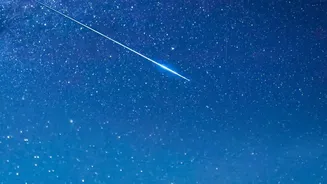
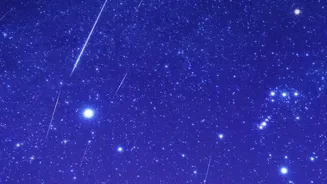
While not as famous as the August Perseids, the September Epsilon Perseids offer a wonderful viewing opportunity this year. This minor meteor shower is active from September 5 to 21, with its peak expected on the night of September 9. Viewers can expect to see
up to five to eight meteors per hour under ideal conditions. The best part? The shower's peak coincides with the period just before the New Moon on September 11, meaning the sky will be dark and moonless, providing excellent conditions for spotting these fleeting streaks of light. For observers in India, the radiant point in the constellation Perseus will be high in the sky in the late night and pre-dawn hours, which is the best time to watch. Find a location away from city lights, let your eyes adjust to the darkness for about 30 minutes, and look towards the northeastern sky.
Venus at Its Brightest
The planet Venus, often called the 'Evening Star,' will be an unmissable, brilliant beacon in the twilight sky this month. It reaches its peak brightness for the entire year around September 19-22, shining at a dazzling magnitude of -4.8. Look for it low on the southwestern horizon shortly after sunset. What's fascinating is that while at its brightest, Venus is actually a slender crescent when viewed through a telescope. This is because its brightness to us is a combination of how much of its sunlit face we see and how close it is to Earth. In late September, it gets close enough that its large apparent size makes up for the fact that we're mostly seeing its unlit side. A pair of steady binoculars might even reveal its crescent shape.
The Autumnal Equinox
On September 23, the Sun will shine directly over the Earth's equator, marking the Autumnal Equinox in the Northern Hemisphere. For India, this occurs in the early morning. While this isn't a visual event you can 'watch' in the sky, it's an important astronomical marker signifying the official start of autumn. From this day forward, the nights will become progressively longer than the days, offering more time for stargazing as we head into the cooler months. The equinox is celebrated in various cultures and is a great reminder of our planet's constant journey around the Sun.
Neptune at Opposition
September 26 offers a challenge for dedicated sky-watchers as the distant planet Neptune reaches opposition. This is the point in its orbit where Earth passes directly between the Sun and Neptune, making the ice giant appear at its closest and brightest for the year. However, due to its immense distance, Neptune is never visible to the naked eye. You will need a good pair of binoculars or, even better, a telescope to spot it. It will appear as a tiny, faint, blue-grey star-like point in the constellation Pisces. On this night, Neptune will rise in the east around sunset and be visible all night long, reaching its highest point in the sky around local midnight.
The Full Harvest Moon
A spectacular double feature concludes the month's celestial events. On the same night that Neptune is at opposition, September 26, the sky will be dominated by the light of the full Harvest Moon. This is the name given to the full moon that occurs closest to the Autumnal Equinox. For several evenings around this date, the Moon rises only about 25-30 minutes later each night, as opposed to the usual 50 minutes. Historically, this provided farmers with extra hours of bright moonlight to bring in their crops. The full moon will officially peak during the daytime in India on September 26, but will appear perfectly full on the nights of September 25, 26, and 27, rising in the east around sunset. While its bright light will wash out fainter stars and make spotting Neptune more difficult, the sight of the large, luminous Harvest Moon rising is a classic astronomical event in itself.