




Our Solar System's Ocean Worlds
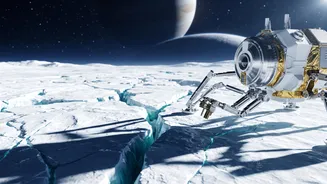
In the cold, outer reaches of our solar system, two small moons have captivated scientists: Jupiter's Europa and Saturn's Enceladus. From the outside, they are worlds of ice, scarred by cracks and fissures. But deep within, the immense gravitational pull
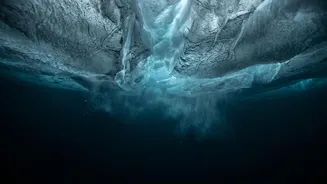
from their giant host planets creates tidal forces, flexing and kneading their cores. This process generates enough heat to maintain vast oceans of liquid salt water beneath their frozen crusts. The existence of liquid water, a key ingredient for life as we know it, makes these moons prime targets in the search for extraterrestrial biology. The fundamental question is no longer just if there is water, but whether these alien seas have the right chemical ingredients to be considered habitable.
Enceladus: Sampling the Geysers
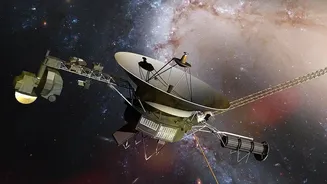
Enceladus offers scientists a tantalizing shortcut. In 2005, NASA’s Cassini spacecraft made a startling discovery: massive plumes of water vapour and ice particles erupting from 'tiger stripe' fractures near the moon's south pole. These geysers shoot hundreds of kilograms of material into space every second, offering a direct sample of the ocean below. Cassini bravely flew through these plumes multiple times, using its instruments to 'taste' their composition. Its cosmic dust analyser and mass spectrometer found not just water, but also salts, silica dust indicative of hydrothermal vents, and a variety of organic molecules—the carbon-based building blocks of life. This direct sampling provided the strongest evidence yet that Enceladus's ocean is a chemically complex and dynamic environment, potentially similar to Earth's own deep-sea hydrothermal systems where life thrives without sunlight.
Europa: A More Difficult Challenge
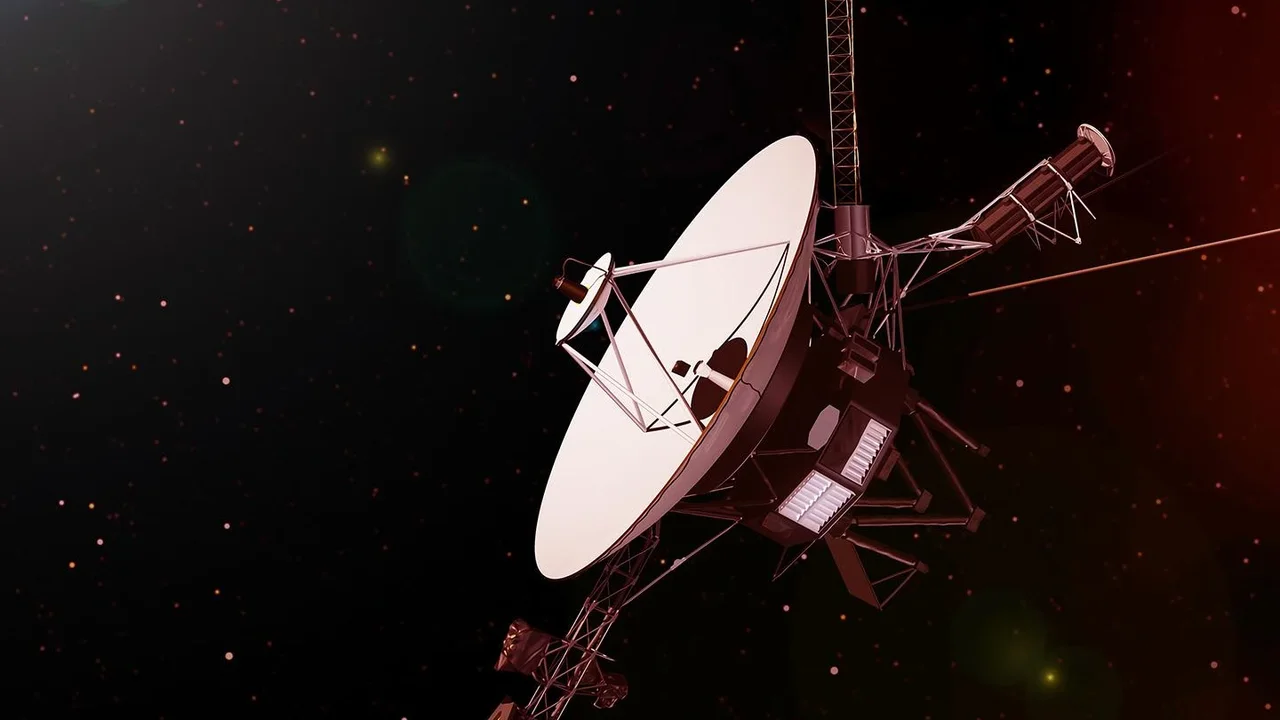
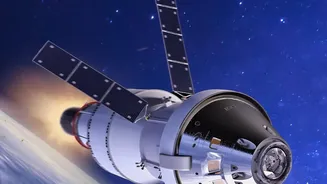
Europa presents a tougher, but perhaps more rewarding, target. Its ice shell is believed to be much thicker than that of Enceladus, possibly tens of kilometres deep. While there is evidence for sporadic plumes, they are not as consistent as Enceladus's geysers. To tackle this challenge, NASA’s Europa Clipper mission is designed for a detailed reconnaissance. Instead of orbiting Europa and getting fried by Jupiter's intense radiation, Clipper will perform dozens of close flybys, swooping in to gather data before retreating to a safer distance. This strategy allows a suite of powerful instruments to get a close-up look, building a comprehensive picture of the moon and its potential habitability without needing to land—at least not yet. The mission is not designed to find life itself, but to determine if the ocean has the right conditions for it.
A Chemist's Toolkit in Space
So how does a probe like Europa Clipper actually scan an ocean from above? It uses a sophisticated toolkit of nine science instruments. An ice-penetrating radar, called REASON, will be one of the stars of the show. It will send radio waves deep into the ice to map its structure, search for the ocean interface, and even identify pockets of trapped water that might be closer to the surface. A magnetometer will measure the salty ocean's depth and conductivity by observing how it interacts with Jupiter's magnetic field. Other instruments, like the MAss Spectrometer for Planetary EXploration (MASPEX) and the SUrface Dust Analyzer (SUDA), are designed to analyse any particles ejected from the surface, whether from plumes or micrometeorite impacts. These instruments can identify the chemical makeup of tiny ice grains, looking for complex organic compounds like amino acids or lipids that could be signs of biological processes.
Searching for Chemical Clues
It's important to understand that these missions are not looking for aliens, but for 'biosignatures'. A biosignature is not life itself, but a chemical trace—a molecule, an isotopic ratio, or a pattern of compounds—that is very difficult to explain through geology alone. Scientists are looking for chemical complexity and imbalances. For example, life on Earth produces specific types of molecules in specific ratios. Finding a similar pattern on Europa or Enceladus would be a monumental discovery. The probes are searching for the 'ingredients for life': liquid water (which we know is there), essential chemical elements (like carbon, hydrogen, nitrogen, oxygen, phosphorus, and sulfur), and a source of energy. By determining if these three conditions are met, missions like Europa Clipper can tell us if these hidden oceans are truly habitable, setting the stage for future missions that might one day drill through the ice and look directly into these mysterious alien seas.