



The Promise of Zero G
Scientists are eager to conduct research in microgravity for a simple reason: it reveals phenomena that are otherwise masked by gravity's pull. On Earth, processes like sedimentation and convection can interfere with delicate experiments. In the near-weightlessness
of the International Space Station (ISS), researchers can study the fundamental nature of materials, grow more perfect protein crystals for drug development, and better understand diseases like cancer and Alzheimer's. They can also investigate the effects of long-duration spaceflight on the human body, from muscle atrophy to bone loss, which is crucial for planning future missions to the Moon and Mars. But getting an experiment from a lab on Earth to the ISS, orbiting 400 kilometres above, is a monumental task that takes years of planning and validation.
The Nerve Centre on the Ground
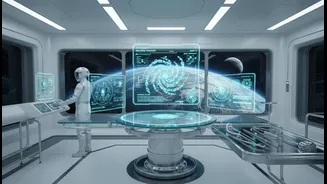
This is where Earth-based control comes in. At the heart of NASA's science operations for the ISS is the Payload Operations Integration Center (POIC) at the Marshall Space Flight Center in Huntsville, Alabama. Staffed 24 hours a day, 365 days a year, this facility is the command post for all U.S. scientific and commercial experiments on the station. Think of it as mission control, but specifically for science. While the Johnson Space Center in Houston handles the station's flight and systems, the POIC is the vital link connecting scientists around the world with their experiments and the astronauts carrying them out. This team coordinates not just with NASA experiments, but also with international partners from Europe, Japan, and Canada, synchronizing all research activities.
From Blueprint to Execution
The work begins long before an experiment reaches orbit. The ground control team is responsible for integrating research requirements and planning the entire mission timeline. They help design experiments that can function within the strict constraints of the ISS, where resources like power and, most importantly, crew time are extremely limited. The ground teams schedule crew training, manage data and command transmissions, and ensure every experiment meets rigorous safety standards. Many experiments are designed to be operated remotely from the ground, a practice known as 'telescience'. Using a sophisticated software toolkit, a scientist in their home university can send commands directly to their payload, receive real-time data, and monitor its health and status without ever speaking to an astronaut.
The 24/7 Watch
Once an experiment is running, the ground team's role shifts to real-time management. A key figure is the Payload Operations Director (POD), who has the ultimate authority over all NASA payload operations and ensures everything runs smoothly and safely. The team constantly monitors hundreds of data streams, tracking the health and status of every scientific instrument. If an anomaly occurs—say, an unexpected bubble in a fluid physics experiment or a sensor malfunction—it's the Operations Controller on the ground who leads the troubleshooting effort. They assess the situation, identify impacts on the timeline, and coordinate with scientists to resolve the issue. If a researcher sees an interesting result and wants to make a change to the experiment, they submit a request to the ground team, who then evaluates its impact and implements the new plan.
The Human Factor
While much can be automated, the human element remains irreplaceable. For experiments that require direct astronaut involvement, the ground team acts as the primary communicators, guiding the crew through complex procedures. This includes everything from setting up hardware to performing delicate tasks, like in the Advanced Diagnostic Ultrasound in Microgravity study, where astronauts performed scans on each other under the guidance of remote medical experts. This collaboration between the crew in space and the controllers on Earth is a finely tuned dance. It relies on meticulous planning, clear communication, and the ability to adapt to unforeseen challenges. The ground team ensures that the precious few hours astronauts have for science are used as efficiently and effectively as possible, maximizing the scientific return on an investment that costs millions.