





A New Window on the Universe
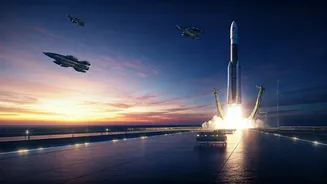
One of the most anticipated events is the launch of NASA's Nancy Grace Roman Space Telescope, currently scheduled for August 30, 2026. This next-generation observatory is poised to be a game-changer for astronomy. While its 2.4-meter primary mirror is the same
size as Hubble's, Roman's wide-field instrument will allow it to capture images covering a sky area at least 100 times larger. This vast field of view will enable it to map the structure and evolution of the universe, hunt for thousands of new exoplanets, and investigate the enduring mysteries of dark matter and dark energy. After launching on a SpaceX Falcon Heavy, Roman will travel to a stable orbit a million miles from Earth, where it will begin its five-year primary mission.
Investigating a Cosmic Collision
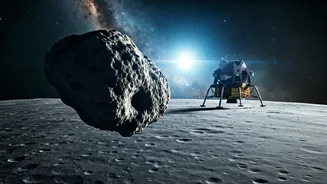
In late 2026, the European Space Agency's Hera mission is scheduled to arrive at the Didymos binary asteroid system. This is a critical follow-up to NASA's successful DART (Double Asteroid Redirection Test) mission, which intentionally slammed a spacecraft into the smaller asteroid, Dimorphos, in 2022 to alter its orbit. Hera's job is to perform a detailed post-impact survey, transforming the kinetic impact experiment into a well-understood planetary defence technique. By studying the crater left by DART and the physical properties of the asteroid, Hera will provide invaluable data on how to effectively deflect a future asteroid that might pose a threat to Earth. The mission, Europe's flagship planetary defender, will also be the first to rendezvous with a binary asteroid system.
China's Lunar Ambitions
China is also set for a significant lunar mission in 2026 with Chang'e 7. The mission is expected to launch in the latter half of the year, targeting the Moon's south pole. This region is of immense scientific interest due to the presence of water ice in permanently shadowed craters. The Chang'e 7 mission will be a comprehensive effort, including an orbiter, a lander, a rover, and a unique mini-flying probe designed to hop into a crater to search for that ice. Understanding the distribution and accessibility of this water is not only key to unlocking secrets about the solar system's history but is also seen as a vital resource for future long-term human outposts on the Moon.
The Race to Mars Heats Up
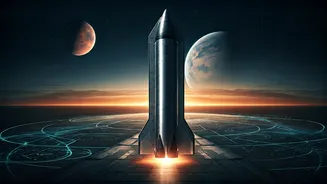
The orbits of Earth and Mars align favorably for launches only once every 26 months, and a key window opens in late 2026. SpaceX has ambitious plans to take advantage of it, stating its intention to launch several uncrewed Starship missions toward the Red Planet. These missions would serve as crucial technology demonstrations, testing Starship's ability to land massive payloads on Mars—a prerequisite for founder Elon Musk's long-term goal of establishing a self-sustaining city there. Separately, the Japanese Aerospace Exploration Agency (JAXA) is targeting a November 2026 launch for its Martian Moons eXploration (MMX) mission. MMX aims to visit Mars's largest moon, Phobos, land on its surface, collect a sample, and return it to Earth, potentially solving the mystery of whether the moons are captured asteroids or remnants of a giant impact on Mars itself.
An Eight-Year Journey's End
After a long and winding voyage that began in 2018, the joint ESA-JAXA BepiColombo mission is scheduled to finally enter orbit around Mercury in November 2026. Getting to the solar system's innermost planet is incredibly challenging due to the Sun's immense gravity. BepiColombo has had to perform nine planetary flybys—one of Earth, two of Venus, and six of Mercury itself—to slow down enough to be captured by the planet's gravity. Upon arrival, the spacecraft will separate into two dedicated orbiters: ESA's Mercury Planetary Orbiter, which will map the planet in great detail, and JAXA's Mercury Magnetospheric Orbiter, which will study its mysterious magnetic field. This two-pronged approach will provide the most comprehensive study of Mercury ever undertaken.