







Living Off the Lunar Land
The key to affordable and sustainable lunar living lies in a concept called in-situ resource utilization (ISRU), which is a fancy way of saying 'using what's already there'. The Moon is covered in a layer of fine, grey dust and rock fragments called regolith.
Launching building materials from Earth is incredibly expensive, so space agencies and private companies are focusing on turning this abundant regolith into a viable construction material. By heating, melting, or binding the lunar soil, it can be transformed into everything from landing pads and roads to the walls of a habitat. This approach not only slashes launch weight and cost but is fundamental to creating a long-term, self-sufficient presence beyond our planet.
Meet the Autonomous Builders
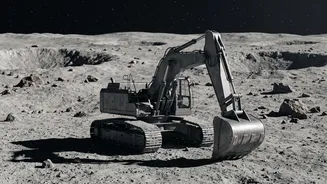
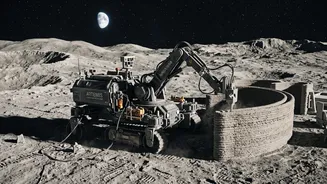
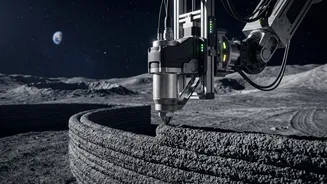
Future lunar construction sites will be crewed not by people in spacesuits, but by teams of advanced robots. These autonomous systems are being designed to handle the entire building process with minimal human oversight. This is crucial because of communication delays with Earth and the need to prepare infrastructure before astronauts even arrive. The technology takes several forms. Some robots will function like rovers, equipped to excavate, grade, and transport regolith. Others will be mobile 3D printers, extruding a building material made from the local soil. For example, Texas-based company ICON is developing its 'Project Olympus' system for NASA, which aims to use high-powered lasers to melt regolith into a durable, ceramic-like substance suitable for building structures layer by layer.
Paving the Way on the Moon
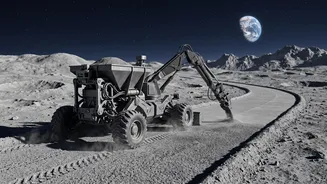
Before habitats can be built, the first priority is often creating stable ground infrastructure like landing pads and roads. Lunar dust is notoriously abrasive and damaging to equipment; rocket engine exhaust can blast it at speeds of several kilometres per second, creating a serious hazard for any nearby structures or vehicles. To solve this, projects are underway to essentially 'pave' parts of the Moon. The European Space Agency's PAVER project explores using concentrated solar power or lasers to melt regolith into solid, glassy surfaces. Similarly, NASA has funded companies like Redwire to develop techniques using microwaves to solidify the soil, creating sturdy surfaces that can withstand rocket plumes and provide smooth pathways for rovers, reducing wear and tear.
The Global Push for Lunar Construction
The race to build on the Moon is a global effort involving both national space agencies and a growing number of commercial players. NASA's Artemis program heavily relies on commercial partners to develop these capabilities through initiatives like the Moon to Mars Planetary Autonomous Construction Technologies (MMPACT) project. The European Space Agency (ESA) is also heavily invested, with plans for its Argonaut lander to deliver cargo and infrastructure starting in the 2030s. Private companies are at the forefront of this innovation. Astrobotic is developing a suite of rovers of various sizes, designed for tasks ranging from scientific analysis to hauling construction payloads. Meanwhile, ICON's multi-million dollar NASA contract to develop its 3D printing technology underscores the shift from conceptual ideas to engineered solutions.
Significant Hurdles Remain
Despite the exciting progress, building on the Moon remains an immense engineering challenge. The environment is one of the most hostile imaginable, with extreme temperature swings from over 120°C in sunlight to -173°C in darkness. The lack of an atmosphere means no protection from constant radiation and the threat of micrometeorite impacts. Furthermore, the regolith itself is tricky. Its fine, sharp particles can clog and damage machinery. Developing robots that are not only durable enough to survive these conditions but also intelligent enough to operate autonomously—navigating terrain without GPS and solving problems without human intervention—is the critical next step that engineers are working to overcome.