





The Wise Elders of Deep Space
When space agencies like NASA launch a multi-million-dollar spacecraft, they design it for a specific mission with a defined lifespan. The Mars rovers Spirit and Opportunity, for instance, were planned for a 90-day mission but ended up working for years.
This incredible longevity is not just a testament to robust engineering; it's a strategic asset. Instead of becoming space junk, these veteran probes are being cleverly repurposed. They have become the wise elders of our solar system, providing invaluable aid to newer, more advanced spacecraft in ways their original designers never imagined. This ecosystem of collaboration, built on decades of presence in space, is making modern exploration cheaper, safer, and more effective. It’s a story of return on investment written in the stars, proving that in space, experience is the ultimate resource.
The Martian Communications Network
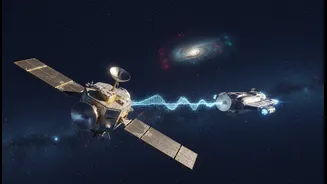
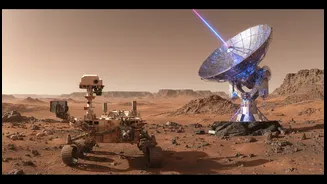
Nowhere is this synergy more apparent than on Mars. The planet is home to a small fleet of orbiters that have long outlived their primary science missions. Prime among them is the 2001 Mars Odyssey, which arrived in 2001 for what was supposed to be a two-year stint. Today, it is the longest-serving spacecraft at the Red Planet. Its most crucial unexpected job? Acting as a deep-space data relay. Rovers on the surface, like Curiosity and Perseverance, generate enormous amounts of high-resolution images and scientific data—far too much to transmit directly to Earth with their limited power and antennas. Odyssey, along with the younger but still veteran Mars Reconnaissance Orbiter (MRO), acts as a go-between. They fly over the rovers, collect their data, and use their own powerful antennas to beam it back to Earth, relaying the vast majority of all information gathered by surface missions.
Scouting and Sentry Duty
Beyond just relaying data, these older orbiters serve as scouts and sentinels for new arrivals. Before the Perseverance rover attempted its nail-biting landing in 2021, the Mars Reconnaissance Orbiter (MRO) had spent years meticulously mapping the Jezero Crater. Its high-resolution camera, HiRISE, identified hazards and helped mission planners choose the safest possible touchdown spot. MRO also provides a different kind of support by monitoring the Martian atmosphere. This weather data is crucial for incoming missions, which rely on aerobraking—using atmospheric friction to slow down—to enter orbit safely. In a remarkable display of coordination, MRO has even managed to photograph spacecraft like Perseverance descending under their parachutes, providing engineers with invaluable data on landing performance. This level of support dramatically reduces the risk for some of the most complex and dangerous phases of any mission.
A Cosmic Collaboration of Telescopes
This principle isn’t confined to Mars. The legendary Hubble Space Telescope, launched in 1990, has been providing breathtaking views of the cosmos for over three decades. When the more advanced James Webb Space Telescope (JWST) came online, it didn't replace Hubble; it began working with it. The two telescopes have different strengths: Hubble excels in visible and ultraviolet light, while Webb is a master of the infrared spectrum. By combining their observations of the same celestial objects, like the galaxy cluster MACS0416, astronomers can create composite, panchromatic images that are far more detailed and comprehensive than either telescope could produce on its own. Hubble's decades of data provide a vital baseline, allowing scientists to build upon its legacy and push deeper into the cosmic frontiers that Webb was designed to explore.
Pioneering the Interstellar Void
Perhaps the most poetic example of missions finding new purpose comes from the twin Voyager spacecraft. Launched in 1977 on a 'grand tour' of the outer planets, their initial mission was completed by 1989 after a flyby of Neptune. Yet, they kept going. Today, both Voyager 1 and 2 have left the heliosphere—the protective bubble of particles and magnetic fields created by our Sun—and are travelling through interstellar space. Their new, unexpected mission is to be humanity's first direct probes of this uncharted territory. Still sending back data from beyond our solar system, they are teaching us about the environment between the stars. Powered by decaying plutonium and operated by a skeleton crew of engineers, the Voyagers represent the ultimate extension of a mission, transforming from planetary explorers into interstellar pioneers.