








Power Strip vs. Surge Protector
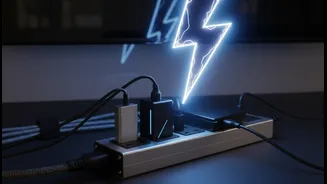
It’s a common and costly mistake to use the terms interchangeably. A basic power strip is simply an extension cord with multiple outlets. It offers convenience by letting you plug in several devices, but it provides zero protection against electrical
fluctuations. A surge protector, on the other hand, looks similar but contains internal components designed to safeguard your electronics from power surges, which are brief spikes in your home's electrical voltage. You can typically tell the difference by checking the packaging or the fine print on the device itself for a specification called a "joule rating." If it has one, it’s a surge protector.
How Surge Protectors Actually Work
Inside most surge protectors is a crucial component called a Metal Oxide Varistor, or MOV. Think of the MOV as a gatekeeper for your electricity. Under normal voltage conditions (in India, that's typically 230V), it does nothing, letting power flow through to your devices. But when it detects voltage above a safe level, its internal resistance instantly drops, and it diverts the excess electrical energy to the grounding wire, preventing it from reaching and frying your sensitive gadgets. This all happens in nanoseconds, providing a shield against common, minor power surges.
Understanding the All-Important Joule Rating
Not all surge protectors are created equal, and the joule rating is the key indicator of its protective capacity. This number tells you how much energy the device can absorb before it fails. The higher the joule rating, the greater the protection. A surge protector rated for 500 joules might be fine for a simple lamp, but for valuable and sensitive equipment like computers, gaming consoles, or a home theatre system, you should look for a rating of 2,000 joules or more. It's important to know that this protection is finite. Each surge, large or small, uses up some of the joules, and once they're gone, the device no longer offers protection, even if it still provides power. Many protectors have an indicator light to show the protection is active.
The Immense Power of a Lightning Strike
This brings us to the main event: lightning. A single lightning bolt can contain up to a billion joules of energy, a force far too powerful for any standard, point-of-use surge protector to handle. Even a nearby strike, not a direct hit, can send a massive surge through power lines that will overwhelm a typical household surge protector. While a surge protector offers excellent defence against smaller, more common surges from the power grid or appliances cycling on and off, it is simply not designed to withstand the catastrophic energy of a lightning strike. No consumer-grade surge protector can guarantee 100% protection against a direct or very close lightning event.
Your Best Defence During a Thunderstorm
So, what is the best way to protect your electronics from lightning? The only truly foolproof method is also the simplest: unplug your valuable equipment from the wall. This physically disconnects your devices from the path the electricity would take. It’s also crucial to remember that surges can travel through any conductive line, not just power cables. This includes ethernet, telephone, and coaxial cables for your TV. For true protection, these should be unplugged as well. For a more robust, permanent solution, you can have a whole-home surge protection device installed at your main electrical panel by a qualified electrician, which provides a first line of defence for your entire home.