


As winter approaches, bringing workouts indoors is a smart move. The step-up is a fantastic, space-efficient exercise for this, but are you unlocking its full potential? The secret lies in a part of the movement many people rush: the step-down.
Your Go-To Winter Exercise
When the
weather turns cold and outdoor activities become less appealing, the simple step-up becomes a hero of home fitness. It requires minimal equipment—just a sturdy bench, box, or even the bottom step of a staircase. This compound exercise is highly effective, targeting major muscle groups in your lower body, including the glutes, quadriceps, and hamstrings. Because each leg works independently, step-ups also help improve balance, stability, and can correct muscle imbalances between your left and right sides. It's a versatile move that can be tailored to any fitness level, making it a cornerstone of an effective indoor workout plan.
The Forgotten Other Half: Eccentric Movement
Most exercises have two main phases: the concentric phase, where the muscle shortens (like when you push up onto the step), and the eccentric phase, where the muscle lengthens under load. In a step-up, the 'step-down' is the eccentric phase. It’s often treated as a throwaway movement—a quick drop back to the floor to prepare for the next rep. However, this is a missed opportunity. Research shows that the eccentric phase is where significant strength gains, muscle growth, and stability improvements are made. By deliberately slowing down and controlling the descent, you place the working muscles under tension for a longer period, which is a powerful stimulus for getting stronger.
Why Control Is Key
Focusing on a slow, controlled step-down offers a host of benefits that go far beyond just working your muscles harder. Firstly, it builds superior stability and control around the knee and hip joints. This controlled deceleration teaches your body to absorb force safely, which is crucial for preventing injuries, not just in the gym but in everyday activities like walking down stairs or navigating uneven ground. Secondly, eccentric training is known to be particularly effective for strengthening tendons and other connective tissues, making them more resilient. This can be especially beneficial for those with knee discomfort, as a controlled step-down helps reinforce proper movement patterns and strengthens the supporting muscles without undue stress on the joint itself.
How to Perfect Your Form
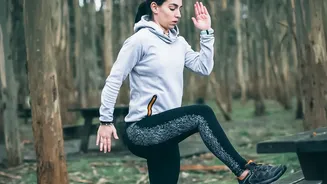
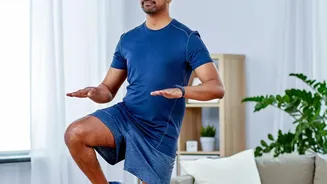
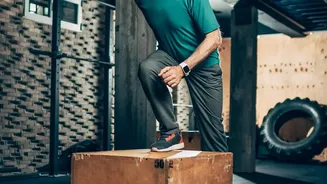
To get the most out of your stepups, form is everything. Start by choosing a step height that is manageable; your knee should be at roughly a 90ndegree angle when you place your foot on it. To begin, stand in front of your step and place one foot fully on the surface. Press through that entire foot to lift your body up, avoiding pushing off with the back leg. The work should come entirely from the leg on the step. At the top, stand tall and balanced. Now for the most important part: the descent. Keeping your weight in the leg on the step, slowly lower your other foot back toward the floor. Aim for a three to five second count on the way down. Your torso should remain upright and your knee should track in line with your toes, not collapse inward. Touch your back foot down lightly before beginning the next rep.
Common Mistakes and How to Progress
Two frequent errors undermine the stepup's effectiveness : choosing a step that’s too high and dropping down too quickly. If you have to heave your body up or you feel unstable ,the step is too high . And by letting gravity do the work on the way down ,you're missing out on the key benefits of eccentric training . Once you have mastered the bodyweight version with excellent control ,you can progress the exercise . The simplest way is to hold dumbbells in each hand to add resistance . You can also increase the challenge by using a slightly higher step ,as long as you can maintain perfect form . For an advanced variation ,try not to let your back foot touch the ground between reps ,hovering it slightly before starting the next stepup to seriously challenge your balance and singleleg strength .