


The Allure of Cosmic Art
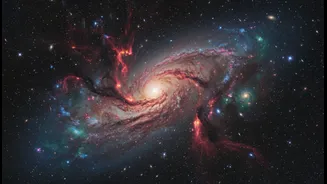
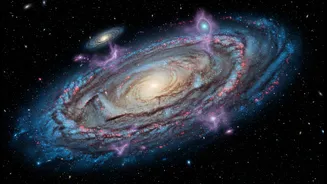
We've all been stopped in our tracks by them: the swirling, colourful clouds of a stellar nursery or the glittering tapestry of a distant galaxy. Images from the Hubble and James Webb Space Telescopes (JWST) have a unique power. They are arguably some
of the most effective tools for public science engagement ever created, inspiring awe and sparking curiosity in people of all ages. These images are meticulously crafted not just for scientific analysis but also for visual impact. They land on the front pages of news sites and go viral on social media, serving as brilliant ambassadors for astronomical research. This visual appeal is crucial; it helps justify the immense cost of these missions and fosters a public appreciation for space exploration. Without the ‘wow’ factor, astronomy would be a much harder sell. But in optimising for beauty, we often sacrifice something equally, if not more, important: a true sense of understanding.
Decoding the Colours of Space
A common misconception is that the vibrant colours are ‘fake’. The more accurate term is ‘false colour’. Telescopes like the JWST observe light in wavelengths invisible to the human eye, such as infrared. Image processors translate these invisible wavelengths into a visible spectrum. Typically, the longest wavelengths are assigned to red, and the shortest to blue, following the natural order of a rainbow. This is not arbitrary artistry; it's a form of data visualisation. It allows scientists, and us, to perceive details that would otherwise be hidden, like the chemical composition of a nebula or the temperature of dust clouds. In this sense, the colour is already a form of measurement context. But simply knowing it is false colour isn't enough. The next, more vital, layer of context is often missing entirely.
The Universe Has No Banana for Scale
The internet has a running joke for providing a sense of size: adding a ‘banana for scale’. While comical, it highlights a fundamental human need to contextualise size. Space images rarely offer us a banana. We see a gorgeous nebula, but have no intuitive grasp of its dimensions. Is it the size of our solar system, or is it trillions of kilometres across? The famous ‘Pillars of Creation’, for instance, are majestic and ethereal. Their beauty is undeniable. But the awe multiplies when you learn the tallest pillar is around four light-years high—that’s the same distance from Earth to its nearest star system. Suddenly, it’s not just a pretty cloud; it's a structure of such monumental scale that our minds can barely contain it. Without this context, we appreciate the art but miss the science. We see the picture, but we don't feel the immensity.
When a Dot Contains Thousands of Galaxies
Perhaps the best argument for context over simple beauty is the Hubble Ultra-Deep Field (HUDF). Visually, it’s a dark patch of sky sprinkled with colourful dots and smudges. It’s interesting, but not as breathtaking as a full-blown nebula. But its context is what makes it one of the most profound images ever taken. That tiny, seemingly empty patch of sky, smaller than a grain of sand held at arm's length, was found to contain an estimated 10,000 galaxies. Each dot is a galaxy, some seen as they were over 13 billion years ago. Knowing this transforms the image from a curious starfield into a dizzying look back to the dawn of the universe. The context—the measurement, the numbers, the scale—is what provides the real, soul-stirring wonder. It demonstrates that an image’s scientific and emotional power is not always tied to its immediate visual splendor.
A More Meaningful Universe
This isn't a call to end beautiful space photography. Rather, it's a plea to enrich it. Science communicators at NASA, ESA, and other institutions are already doing incredible work, but making measurement context a standard part of every image release can deepen the public’s connection to their discoveries. It doesn’t have to be complicated. A simple scale bar, an annotation, or a caption that states “this cloud is 50 light-years across” or “each bright spot is a cluster of a thousand stars” can fundamentally change how we perceive an image. It shifts the viewer from a passive admirer of art to an active participant in understanding a scientific marvel. By pairing aesthetic appeal with accessible, mind-blowing measurements, we don't diminish the beauty; we give it meaning, weight, and a power that resonates far more deeply.