







Puri: The Epicentre of Faith
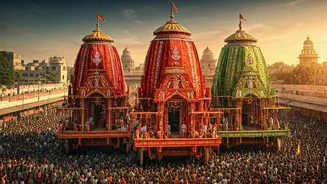
The Rath Yatra of Puri in Odisha is the original and largest of its kind, with a history stretching back centuries. [26, 21] Every year, on the second day of the bright fortnight of the month of Ashadha, the deities Jagannath, his brother Balabhadra,
and sister Subhadra journey from their temple abode to the Gundicha Temple, about three kilometres away. [3, 15] This journey is made on three colossal, newly built wooden chariots pulled by thousands of devotees. [7, 26] The festival symbolises a journey of the divine coming out to meet the people, breaking down barriers of caste and creed. [4] It is this spectacle of devotion that has given the English language the word 'juggernaut', derived from Jagannath, signifying an unstoppable force. [12, 22] The week-long festival culminates in the 'Bahuda Yatra', the return journey to the main temple. [4]
Ahmedabad: A Tradition of Grandeur
After Puri, the Rath Yatra in Ahmedabad, Gujarat, is considered the second-largest and one of the oldest in India, having started in 1878. [14, 6] Inspired by a dream and a pilgrimage to Puri, Mahant Narsinhdasji began the tradition at the Jagannath Temple in Jamalpur. [11, 6] The procession here follows a 14-kilometre route through the city. [18] A key ritual is the 'Pahind Vidhi', where the Chief Minister of Gujarat symbolically sweeps the path for the chariots with a golden broom, signifying that all are servants before the Lord. [11, 14] The yatra features decorated elephants, cultural troupes (akharas), and a massive public turnout, making it a significant 'Lokotsav' or public festival for the state. [6, 18]
Kolkata and Mahesh: Bengal's Devotional Fervour
West Bengal hosts several significant Rath Yatras, each with its unique history. The Rathayatra of Mahesh in Serampore is the oldest in Bengal and the second oldest in India after Puri, reportedly celebrated since 1396. [22, 23] It is a massive week-long festival and fair. [23] In Kolkata, the International Society for Krishna Consciousness (ISKCON) started its Rath Yatra in 1972, replicating the grand tradition of Puri and making it a major event in the city's cultural calendar. [16] The chariots journey to a temporary camp at Brigade Parade Ground, where they remain for seven days. [16] Beyond these, smaller yet deeply traditional yatras take place in other parts of Bengal like Guptipara and Rajbalhat, each contributing to the region's rich Vaishnava heritage. [16]
A Global Phenomenon
The spirit of Rath Yatra has crossed oceans, thanks in large part to the efforts of ISKCON founder A. C. Bhaktivedanta Swami Prabhupada. [9, 13] He organised the first Rath Yatra outside of India in San Francisco in 1967. [13, 19] Since then, the festival has become a global celebration, observed in major cities like New York, London, Dublin, Toronto, Sydney, and Moscow. [3, 9, 19] In Durban, South Africa, the festival has been celebrated on the shoreline since 1988. [19] Devotees in Prague pull a 40-foot chariot through the streets, and even in Moscow, followers have braved freezing temperatures to participate. [19] These international celebrations bring together people of all backgrounds, featuring kirtan, prasadam distribution, and cultural programs, transforming city streets into vibrant parades of devotion. [9, 20] A 2016 survey noted over 500 ISKCON-led Rath Yatras happening annually across the globe. [17]