





The Problem in a Vacuum
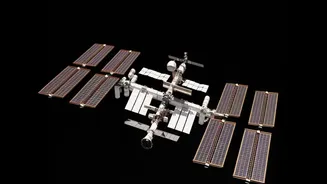
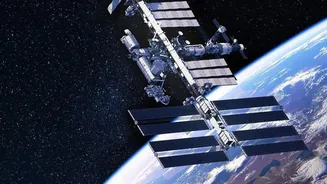
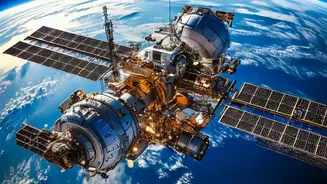
You can’t just open a window on the International Space Station (ISS). In a perfectly sealed environment, every breath an astronaut exhales becomes a problem. They breathe out carbon dioxide (CO2), a harmless gas on Earth where it dissipates, but a deadly
poison in an enclosed space. Without intervention, the CO2 level would quickly rise to toxic levels, leading to headaches, dizziness, and eventually suffocation. At the same time, each breath releases water vapor, which would make the station’s air uncomfortably humid and cause condensation on vital electronic equipment. Managing this exhaled air isn't just about comfort; it's a fundamental challenge of survival in space.
The Station's Lungs and Kidneys
The solution is a symphony of machinery known as the Environmental Control and Life Support System, or ECLSS. Think of it as the station’s mechanical heart, lungs, and kidneys all rolled into one. This sophisticated system maintains the station's atmospheric pressure, temperature, and composition. Its most critical job, however, is air revitalization: taking the stale, CO2-rich air and making it breathable again. It’s a closed-loop system designed to recycle as much as possible, because launching new supplies like water and oxygen from Earth is incredibly expensive and, for future deep-space missions, nearly impossible.
Scrubbing CO2 from the Air
The first step in recycling a breath is capturing the carbon dioxide. On the ISS, this is handled by the Carbon Dioxide Removal Assembly (CDRA). Air is continuously circulated through this device, which contains beds of a porous, sponge-like mineral called zeolite. These zeolite beds act as a molecular sieve, with tiny pores that are the perfect size to trap CO2 molecules while letting oxygen and nitrogen pass through freely. The system is regenerative, meaning it doesn't require disposable filters. It operates with multiple beds; while one is absorbing CO2 from the cabin air, another is exposed to the vacuum of space, which sucks the trapped CO2 out and vents it away, cleaning the bed for the next cycle.
Turning Bad Air into Good Water
While venting CO2 gets rid of the immediate danger, it also discards precious oxygen atoms. That’s where a brilliant piece of chemistry called the Sabatier process comes in. The captured CO2 is sent to the Sabatier system, where it’s mixed with hydrogen. This hydrogen isn’t just lying around; it's the waste product from the station’s Oxygen Generation System, which produces breathable oxygen by splitting water molecules (a process called electrolysis). Inside the Sabatier reactor, over a heated catalyst, the carbon dioxide and hydrogen react to produce two new things: water (H2O) and methane (CH4). This newly created water is a massive win. It can be used for drinking or fed back into the oxygen generator to be split into more breathable air. The methane is currently considered a waste product and vented into space.
Don't Waste a Single Drop
The other key component of exhaled breath is water vapor. Along with sweat, this moisture is captured by dehumidifiers in the station's atmosphere. This collected water is sent to the Water Recovery System, a powerful purification plant. This system also processes wastewater and even urine, using a series of filters and distillers to create water that is cleaner than what most people drink on Earth. Nearly 98% of all water on the station is recovered and reused in this remarkable loop. The water produced is used for everything: drinking, rehydrating food, hygiene, and producing more oxygen.
Innovations for Mars and Beyond
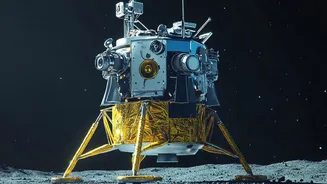
The systems on the ISS are engineering marvels, but they are still not 100% efficient. For long-duration missions to the Moon and Mars, where resupply is not an option, failure is not either. NASA and other space agencies are developing the next generation of life support systems that are even more reliable, smaller, and more efficient. Technologies like the Advanced Closed Loop System (ACLS) aim to improve the CO2-to-oxygen conversion process, reducing waste. Researchers are also exploring ways to use the methane byproduct from the Sabatier reaction as fuel, and even how to extract resources like oxygen directly from the Martian atmosphere. These closed-loop systems are the key to making humanity a multi-planetary species.