


From Island Universes to a Cosmic Web
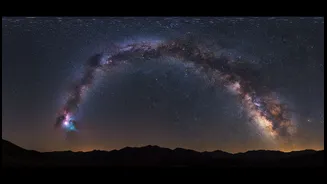
For much of modern astronomy, galaxies were seen as solitary ‘island universes’ scattered randomly through the vastness of space. Our own Milky Way was a prime example, a self-contained city of stars. But as our observational tools grew more powerful,
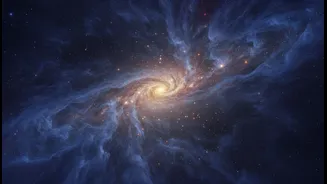
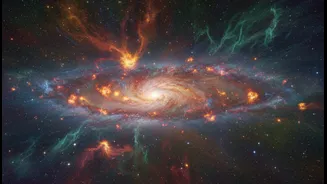
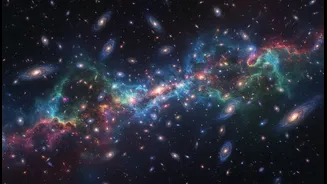
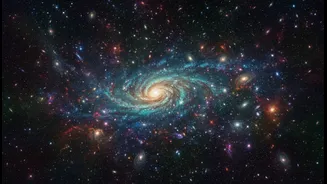
a new, grander picture emerged. Scientists discovered that galaxies are not randomly distributed at all. Instead, they are organized into an immense, intricate structure known as the cosmic web. This web consists of dense hubs called clusters, connected by long, thread-like filaments of galaxies, all surrounding vast, nearly empty regions called voids. To understand a galaxy's life story, we can no longer just study it in isolation; we must consider its place within this cosmic neighborhood.
The Power of a Wide-Angle View
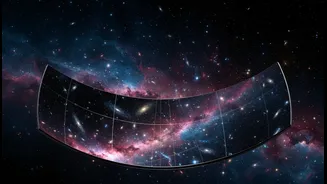
The “wider cosmic lens” isn’t a single instrument, but a new approach to astronomy embodied by ambitious projects like the Vera C. Rubin Observatory and the Euclid space telescope. Instead of focusing on single, specific targets, these surveys scan huge portions of the sky over and over. The Rubin Observatory, for example, will image the entire southern sky every few nights for a decade, creating an unprecedented time-lapse movie of the cosmos. This wide-and-deep strategy allows astronomers to create massive 3D maps charting the positions of tens of millions of galaxies across cosmic time. By doing so, they can directly observe the structure of the cosmic web and study how it has changed over billions of years.
Clustering as a Map of the Invisible
One of the most profound insights from studying galaxy clusters is that what we see is only a tiny fraction of what’s there. The visible matter of stars and gas is held together by something we cannot see: dark matter. This mysterious substance is estimated to make up about 85% of the matter in the universe and acts as an invisible scaffold upon which the cosmic web is built. Galaxies and clusters form within the densest concentrations of this dark matter, essentially tracing its structure. By mapping how galaxies cluster, scientists can therefore map the distribution of dark matter and study its properties, a key step in solving one of cosmology's biggest mysteries. The way galaxies are pulled together by gravity provides crucial clues about the fundamental forces shaping the universe.
How Your Cosmic Address Shapes Your Destiny
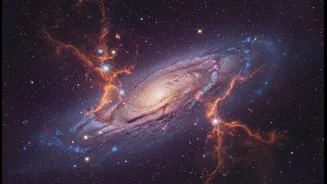
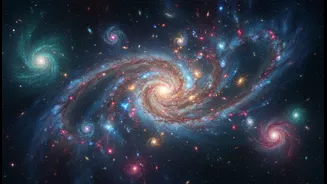
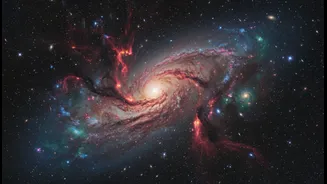
It turns out that a galaxy’s environment is a primary factor in its evolution. Galaxies located in the bustling ‘urban centers’ of dense clusters have very different lives from their cousins in the quiet 'rural' voids. Cluster galaxies are often subjected to violent interactions. They can collide and merge with others, or have their gas stripped away as they plunge through the hot gas that fills the cluster. This process shuts down their ability to form new stars, turning them into ‘red and dead’ elliptical galaxies. In contrast, isolated galaxies or those in less-crowded filaments tend to be blue, spiral-shaped, and actively forming new stars. By studying thousands of galaxies in different environments, surveys can piece together the lifecycle of a galaxy from its star-forming youth to its quiescent old age.
A Time Machine to the Early Universe
Because light takes time to travel across the cosmos, looking at distant galaxies is like looking back in time. A galaxy a billion light-years away is seen as it was a billion years ago. The new wide-field surveys, which can detect incredibly faint and distant objects, act as powerful time machines. They allow astronomers to see the cosmic web when the universe was much younger and watch how clusters and filaments assembled over cosmic history. Recent observations from the James Webb Space Telescope have already revealed that the first galaxies were forming just a few hundred million years after the Big Bang and were more mature than expected. These cosmic lenses are providing a scrapbook of galactic evolution, showing us the universe in its infancy, adolescence, and adulthood.