



The Cosmic Detective Technique
Imagine trying to figure out the ingredients of a cake just by looking at the shadow of the person who baked it. It sounds impossible, but that's a simplified way of thinking about how astronomers study exoplanets—planets orbiting stars other than our
Sun. The primary tool for this cosmic detective work is called spectroscopy, and it allows scientists to analyse the chemical makeup of a planet's atmosphere from light-years away. This is done through a specific method known as transit spectroscopy. For this to work, a planet's orbit must be perfectly aligned from our viewpoint, so that it passes directly in front of its star. This event is called a 'transit'.
Reading the Rainbow of Starlight
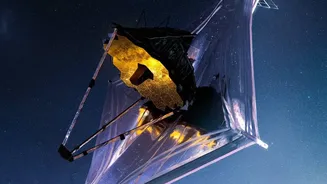
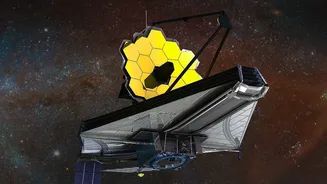
During a transit, a tiny fraction of the star's light filters through the upper edges of the planet's atmosphere before it reaches our telescopes, like the James Webb Space Telescope (JWST). This is where the magic happens. Every gas and chemical molecule has a unique property: it absorbs very specific colours, or wavelengths, of light. Think of it as a chemical 'fingerprint'. When the starlight passes through the exoplanet's atmosphere, molecules like water vapour or methane absorb their characteristic colours, leaving tiny, dark lines in the star's rainbow of light, known as a spectrum. By looking for these missing colours, astronomers can confidently say which gases are present.
The Search for Water
Water is a top priority in the search for habitable worlds, since all known life depends on it. Using transit spectroscopy, space telescopes have successfully detected water vapour in the atmospheres of numerous exoplanets. For example, the powerful JWST has captured the unmistakable signature of water on planets like WASP-96 b, a gas giant located hundreds of light-years away, proving the atmosphere contained water and clouds. More recently, in mid-2026, studies of another planet called WASP-39 b not only confirmed large amounts of water but even detected a special, heavier variant of water known as semi-heavy water. These detections demonstrate the incredible power of spectroscopy to parse the fine details of alien skies.
Why Methane is a Tantalizing Clue
Beyond water, the detection of methane is particularly exciting for scientists. While it can be produced by geological processes like volcanoes, on Earth, the vast majority of methane in our atmosphere is produced by living organisms. Methane doesn't last long in an atmosphere, as it's broken down by starlight. Therefore, finding a large, steady amount of it on a rocky exoplanet could imply that something is constantly replenishing it—and that 'something' could potentially be life. However, scientists are cautious. The presence of methane is not definitive proof of life, as it can have non-biological origins. Context is key; scientists look for methane in combination with other gases, like carbon dioxide, to better assess whether its source is more likely to be biological or geological.
Putting It All Together with JWST
The James Webb Space Telescope has been a game-changer for this field, with its advanced instruments capable of capturing incredibly detailed infrared spectra. This allows it to detect a wide range of molecules. For instance, observations of the gas giant WASP-80 b revealed definitive signs of both methane and water vapour. Studying the ratio of different elements, like carbon to oxygen, from these findings can even provide clues about where and how the planet originally formed in its solar system. A September 2026 study of another giant planet, HATS-6 b, also used JWST to identify water, methane, and even ammonia, a molecule rarely detected on exoplanets before. Each new detection helps build a more complete picture of the diversity of planets in our galaxy.