



Hours spent hunched over a desk can lead to more than just a stiff back. It can cause key muscle groups to switch off, leading to what some call 'gluteal amnesia' or 'dead butt syndrome'. This guide offers a way to fight back and wake them up.
The Problem: A Sedentary Shutdown
A modern
desk job often means sitting for prolonged periods. This posture shortens and tightens the muscles at the front of your hips (hip flexors) and lengthens and weakens the muscles at the back—namely, your glutes. This imbalance can lead to poor posture, lower back pain, and inefficient movement patterns. The glutes, which should be the powerhouse of your lower body, essentially 'forget' how to fire correctly because they are constantly compressed and underused. Similarly, the muscles in your upper back that are responsible for keeping your shoulders pulled back become weak, leading to the classic 'desk slump' or rounded shoulders. The goal is to counteract these effects by activating the sleepy muscles and stretching the tight ones.
1. Glute Bridges: Awaken Your 'Dead Butt'
The glute bridge is one of the most effective exercises for re-establishing the mind-muscle connection with your glutes. It isolates and activates the gluteus maximus, teaching it to fire again after long hours of inactivity. To perform it, lie on your back with your knees bent and feet flat on the floor, about hip-width apart. Place your arms by your sides. Engage your core and lift your hips toward the ceiling until your body forms a straight line from your shoulders to your knees. Squeeze your glutes hard at the top of the movement and hold for a few seconds before lowering your hips back down with control. Avoid arching your lower back; the work should come entirely from your glutes.
2. Bird-Dog: Build Core Stability
The bird-dog is a fantastic exercise for improving core stability, which is crucial for protecting the spine, especially when other muscles are weak. It also helps coordinate the activation of your glutes and shoulder stabilisers. Start on all fours with your hands directly under your shoulders and your knees under your hips. Keeping your back flat and your core engaged, slowly extend your right arm forward and your left leg backward simultaneously. Reach long, as if being pulled in opposite directions, rather than reaching high. Hold for a moment without letting your hips or torso rotate, then return to the starting position with control. Repeat on the other side, alternating for several repetitions.
3. Kneeling Hip Flexor Stretch: Release Tight Hips
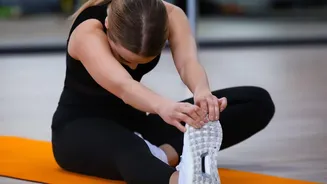
Since prolonged sitting keeps your hip flexors in a shortened position, actively stretching them is essential for restoring posture and relieving lower back strain. Start in a kneeling lunge position, with your right knee on the floor and your left foot forward, creating a 90-degree angle at the left knee. Keeping your torso upright, gently tuck your pelvis and shift your hips forward until you feel a gentle stretch in the front of your right hip and thigh. Be careful not to arch your back. Hold the stretch for at least 30 seconds, breathing deeply, before switching to the other side.
4. Face Pulls : Fix Rounded Shoulders
To combat the forward slump of desk posture, you need to strengthen the muscles of your upper back, including the rhomboids and rear deltoids. Face pulls are excellent for this. Set a cable machine pulley to face height and attach a rope handle. Grasp the rope with an overhand grip and step back to create tension. Pull the ropes toward your face, aiming to bring your hands to either side of your head. As you pull, focus on squeezing your shoulder blades together. This movement directly counteracts the forward -rounding motion of the shoulders and helps improve your standing and sitting posture.
5. Planks : Re -engage Your Entire Core
While the bird -dog targets deep stabilisers, the plank is a static hold that strengthens the entire core musculature, including the abdominal wall, which supports the lower back. This is vital when weak glutes have been forcing the back to overcompensate. To perform a plank, assume a push -up position but rest your weight on your forearms instead of your hands. Your body should form a straight line from your head to your heels. Brace your core, engage your glutes, and prevent your hips from sagging or rising too high. Hold this position for as long as you can maintain perfect form, building up your time gradually.