

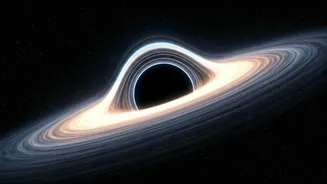


A Reservoir of Cosmic Proportions
In a discovery that reshapes our understanding of the early universe, astronomers have identified the largest and most distant reservoir of water ever detected. [2, 5] This enormous mass of water vapor, equivalent to 140 trillion times all the water in Earth's
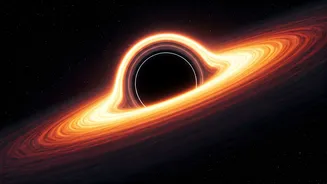
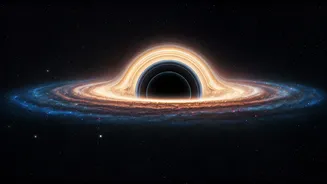
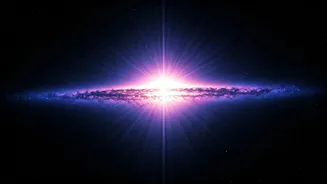
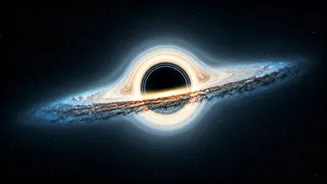
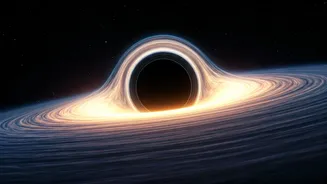
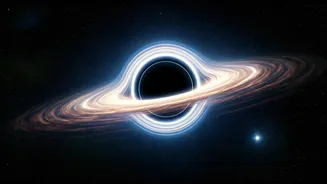
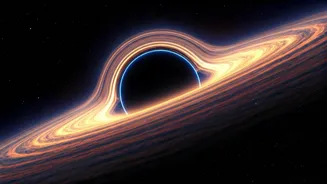
oceans, surrounds a supermassive black hole at the heart of a quasar known as APM 08279+5255. [1, 2, 3] A quasar is an incredibly bright and energetic object powered by a black hole actively feeding on surrounding gas and dust. [2, 5] Located more than 12 billion light-years away, this discovery provides a look back in time to when the universe was only about 1.6 billion years old, offering clues about its formative years. [2, 8]
What Exactly Is This 'Cloud'?
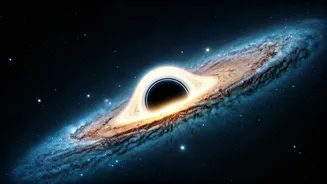
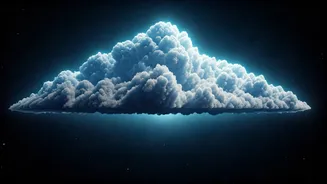
It's important to clarify that this isn't a fluffy white cloud or a giant floating ocean. The water exists as vapor, distributed across a vast gaseous region spanning hundreds of light-years. [2, 5] This region is wrapped around a monstrous black hole estimated to be 20 billion times the mass of our sun. [2] The environment is far from gentle. The quasar blasts the surrounding gas with X-rays and infrared radiation, creating conditions that are unusually warm and dense by cosmic standards. [5, 10] While the gas is technically chilly at around minus 53 degrees Celsius, it's still five times hotter and up to 100 times denser than what is typical in galaxies like our own Milky Way. [5, 10]
How Did Astronomers Find It?
Detecting water from 12 billion light-years away is a monumental feat of science. Two independent teams of astronomers made the discovery using different powerful observatories. [2, 4] One team used an instrument called Z-Spec at the Caltech Submillimeter Observatory in Hawaii, while another used the Plateau de Bure Interferometer in the French Alps. [4, 8] These instruments operate in the millimeter and submillimeter wavelengths of light. They can detect the unique spectral 'fingerprint' that water molecules emit. [7, 8] By analyzing these light signatures, scientists were not only able to confirm the presence of water but also estimate its incredible mass and physical properties. [4, 7]
Putting the Scale in Perspective
The sheer amount of water is difficult to comprehend. The 140 trillion times figure dwarfs our own galaxy's water content. The Milky Way has water vapor, but about 4,000 times less than what's in this single quasar, primarily because most of our galaxy's water is locked up as ice. [2, 5] In APM 08279+5255, the water vapor acts as a crucial tracer gas. Its presence and characteristics reveal details about the nature of the quasar, showing it is bathing its surroundings in immense energy. [5] Scientists believe there is enough gas and dust, including the water vapor, to potentially allow the central black hole to grow to six times its current size. [4]
Why This Discovery Is So Important
Finding such a massive quantity of water so early in the universe's history is a game-changer. It demonstrates that water has been a pervasive and abundant component of the cosmos from a very early stage. [2, 5] Water is a crucial molecule, not just for life as we know it, but also for the processes of star formation. It helps cool the giant clouds of gas that eventually collapse to form new stars. [10] This discovery proves that the essential elements for this process, like oxygen (a component of water), were present much earlier than previously thought, enriching space and setting the stage for the formation of galaxies, stars, and potentially life. [7]