






The Sun's Hottest Enigma
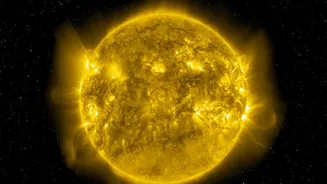
Imagine standing near a campfire and feeling colder the closer you get. That’s the puzzle the Sun presents. Its visible surface, the photosphere, registers a temperature of about 5,500 degrees Celsius. Logically, anything further away should be cooler.
Yet, the Sun's outer atmosphere, the corona, sizzles at over a million degrees. This phenomenon, known as the 'coronal heating problem', has baffled solar physicists for decades. How does the corona get so incredibly hot while being so far from the Sun's core energy source? Scientists believe the answer lies in the complex interplay of magnetic fields and plasma, but the exact mechanism has remained elusive. This isn't just an academic question; the processes that heat the corona also fuel space weather that can impact Earth.
India’s Unblinking Eye on the Sun
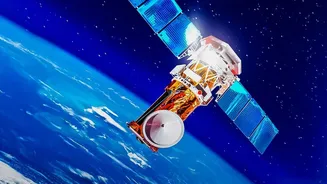
Enter Aditya-L1, the Indian Space Research Organisation's (ISRO) first dedicated solar observatory. The mission is a significant milestone for India, marking its foray into advanced solar research. To solve the corona mystery, you need to watch the Sun constantly. Aditya-L1 is strategically parked at Lagrange Point 1 (L1), a spot 1.5 million kilometres from Earth where the gravitational pull of the Sun and Earth cancel each other out. This unique vantage point allows the spacecraft to have a continuous, uninterrupted view of the Sun, without any eclipses or occultations caused by the Earth. This 24/7 observation is critical for tracking the dynamic and often rapid changes in the Sun's atmosphere.
The Corona's Chief Investigator: VELC
The primary instrument onboard Aditya-L1 for this task is the Visible Emission Line Coronagraph, or VELC. A coronagraph is a special kind of telescope that creates an artificial eclipse, blocking the blindingly bright light from the Sun's disk. This allows it to see the much fainter corona surrounding it. But VELC is more than just a camera. It's designed for simultaneous imaging, spectroscopy, and spectro-polarimetry. In simpler terms, it can not only take pictures of the corona but also break down its light to measure crucial properties like temperature, velocity, and density of the coronal plasma. It's this diagnostic capability that makes VELC a powerful tool for getting to the root of the heating problem.
How VELC Probes the Heat
VELC's job is to hunt for the fingerprints of the heating mechanism. By studying the spectral lines in the corona's light, scientists can build a 3D map of its temperature and the speed at which plasma is moving. One leading theory is that the corona is heated by energy transferred from the Sun's churning magnetic fields, perhaps through countless tiny explosions called 'nanoflares' or by magnetic waves. Recent findings from Aditya-L1 have already suggested that the constant reconfiguring of the Sun's magnetic field could be a major contributor to this heat. VELC’s high-resolution and multi-faceted observations are designed to capture evidence of these processes in action, tracking how energy is transferred from the surface up into the atmosphere.
A Team of Solar Detectives
While VELC focuses on the corona, it doesn't work alone. Aditya-L1 carries a suite of seven instruments that work in concert. The Solar Ultraviolet Imaging Telescope (SUIT), for example, provides crucial context by observing the layers just below the corona—the photosphere and chromosphere. Since the heating process likely starts lower down in the solar atmosphere, observing these layers simultaneously is key. SUIT can see how magnetic structures evolve on the surface and track how that energy travels upwards to affect the corona. By combining data from VELC, SUIT, and X-ray spectrometers like SoLEXS, scientists get a complete picture of the energy flow through the Sun's atmosphere, from bottom to top.
Why This Solar Puzzle Matters
Solving the coronal heating mystery is fundamental to understanding our star, but it also has practical implications for us on Earth. The same explosive energy releases that heat the corona are responsible for solar flares and Coronal Mass Ejections (CMEs)—giant eruptions of solar material that get hurled into space. When aimed at Earth, these events can trigger geomagnetic storms that disrupt satellite operations, GPS navigation, communication networks, and even power grids. By providing crucial data on the Sun's behaviour, Aditya-L1 enhances our ability to forecast this 'space weather', helping to protect our increasingly technology-dependent civilisation from the Sun's unpredictable temperament.