





Viral videos show humanoid robots running, sorting objects, and even folding laundry. But as the novelty fades, a tougher question emerges: Can these marvels of engineering actually do a job well enough, and cheaply enough, to be worth it?
The Promise of a Robotic Workforce
The vision is compelling.
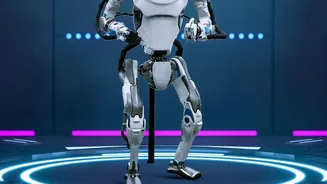
Companies like Tesla, Figure AI, and Agility Robotics are developing autonomous, two-legged robots designed to work in environments built for humans. The goal isn't just to automate a single, repetitive action, as fixed industrial arms have done for decades. The promise is a general-purpose worker that can tackle multiple tasks, from logistics and warehousing to manufacturing and eventually, elder care and household chores. In theory, a robot that can navigate human spaces could be a game-changer for labour-strapped industries, taking on dangerous or monotonous jobs. The market potential is enormous, with some analysts forecasting it could reach $38 billion by 2035. This vision has attracted massive investment, with Figure AI alone raising $675 million in a single funding round after announcing a partnership with BMW.
The Sobering Reality of Cost
Despite rapid progress, the biggest hurdle is economic. Impressive demonstrations don't always translate to commercial readiness. The central challenge is proving that the value of the work performed by a robot is greater than its total cost of ownership. Purchase prices for industrial-grade humanoids can range from $80,000 to over $250,000 per unit. But the sticker price is just the beginning. Total deployment costs can be much higher, including an extra $18,000 to $80,000 for essential software integration, safety certifications, and staff training. While some manufacturers target a future price of $20,000 to $30,000, achieving a positive return on investment today is a complex calculation that depends heavily on the specific task and the robot's reliability.
From Demo to Deployment
The industry is now in a critical phase of moving from controlled demos to real-world pilot programs. Figure AI's partnership with BMW is a key example, where its robots have been deployed on a live production line, handling sheet metal and contributing to the assembly of tens of thousands of vehicles. Similarly, Agility Robotics has a commercial deal with GXO Logistics to use its 'Digit' robot in warehouses. However, even in these promising deployments, challenges remain. Issues like battery life, which often limits a robot to just a few hours of work before needing a recharge, are a significant operational bottleneck. As of mid-2026, Elon Musk noted that Tesla's Optimus robots, while deployed in factories, were primarily for data collection and learning, not yet performing economically productive tasks. Recently, in early November 2026, Xiaomi announced one of its humanoid robots worked a full eight-hour shift in an EV factory, a significant milestone for hardware endurance.
The Unseen Hurdles
Beyond cost and battery life, a host of engineering problems must be solved for widespread adoption. Reliability is paramount; customers expect 95%–99% uptime, but many robots still require frequent human intervention. Dexterity is another major challenge. Human hands are marvels of engineering, and replicating their ability to handle a wide variety of objects with appropriate force is incredibly difficult. Furthermore, the AI software that powers these machines must be able to generalize, adapting to unfamiliar situations and objects that weren't in its training data. Finally, ensuring these powerful, mobile machines can work safely alongside people is a nonstoppable requirement for which industry standards are still being developed.