




Putting the Numbers on the Board
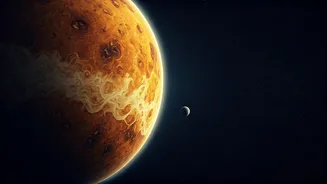
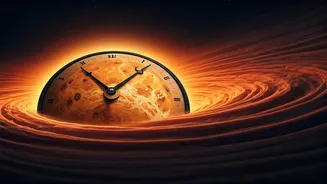
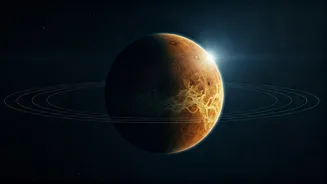
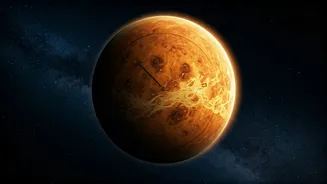
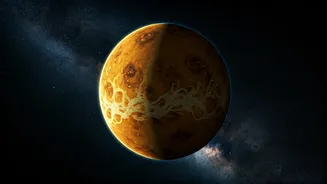
Let’s break down this mind-bending timeline. A 'year' is the time it takes a planet to complete one full orbit around its star. For Venus, this journey around the Sun takes about 225 Earth days. A 'day,' however, refers to a single axial rotation—the
time it takes for the planet to spin once on its axis. On Venus, this process is astonishingly sluggish, taking a full 243 Earth days. So, yes, the planet completes a full trip around the Sun before it even finishes a single spin. It’s the only planet in our solar system where a day is longer than a year, making its calendar completely alien to our Earthly experience.
The Culprit: A Crushing Atmosphere
So, why does Venus spin so slowly? The leading theory points to its incredibly thick, heavy atmosphere. The air on Venus is about 96% carbon dioxide and so dense that the pressure at the surface is 92 times that of Earth at sea level—equivalent to being nearly a kilometre deep in our ocean. This super-thick atmosphere churns with powerful winds and creates massive 'atmospheric tides.' Unlike the ocean tides on Earth pulled by the Moon, these are bulges in the atmosphere caused by solar heating. This dense, flowing atmosphere acts like a brake, exerting a powerful drag on the planet's surface. Over billions of years, this constant friction has slowed Venus’s rotation to its current leisurely pace.
Spinning the Wrong Way
As if a day longer than its year wasn't strange enough, Venus also spins backward. While Earth and most other planets in the solar system rotate from west to east (prograde), Venus rotates from east to west (retrograde). If you could stand on its scorching surface, you would see the Sun rise in the west and set in the east. Scientists believe this retrograde motion is a key part of the puzzle. Some models suggest that a massive collision with a large asteroid or protoplanet in the distant past could have flipped its axis or reversed its spin. Others propose that the same powerful atmospheric tides that slowed it down, combined with friction between its core and mantle, could have eventually caused the planet’s spin to reverse entirely.
A Day vs. a Solar Day
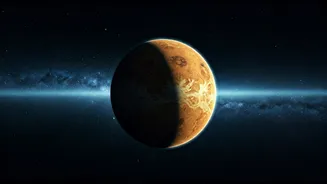
Here’s where it gets even stranger. While its axial rotation (sidereal day) is 243 Earth days, the time from one sunrise to the next (solar day) is much shorter, about 117 Earth days. How is this possible? Because the planet is rotating backward while orbiting the Sun. Imagine walking backward on a moving train; your journey relative to the inside of the train is different from your journey relative to the ground. Similarly, Venus's retrograde spin 'fights' its orbital motion, causing the Sun to appear to move across the sky more quickly than the planet's actual rotation speed would suggest. It's a complex celestial dance that makes 'a day on Venus' a confusing term without further clarification.
A Hellish Connection
This bizarre rotation is not just a quirky feature; it's deeply connected to why Venus is such an inhospitable, 'hellish' world. The slow spin means Venus lacks a strong internal dynamo effect, which is what generates Earth's protective magnetic field. Without a significant magnetic field, Venus is left exposed to the solar wind, which has stripped away lighter elements like water from its upper atmosphere over aeons. Furthermore, the incredibly long days and nights contribute to its runaway greenhouse effect. The surface bakes under the Sun for months at a time, reaching and maintaining temperatures around 465°C, hot enough to melt lead. There is no significant cooling on the night side because the thick atmosphere traps heat with brutal efficiency.