





An Ocean World in Deep Space
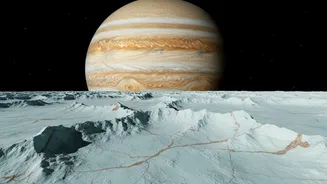
Jupiter’s moon Europa has fascinated scientists for decades. While its surface is a frozen wasteland with temperatures dropping to minus 220 degrees Celsius, evidence strongly suggests a different world lies beneath. Data from NASA's Galileo probe in the
1990s revealed a disruption in Jupiter’s magnetic field around Europa, hinting at a global layer of electrically conductive fluid – most likely a salty ocean. Scientists now believe this subsurface ocean could contain more than twice the amount of water found in all of Earth's oceans combined. The possibility of liquid water, a key ingredient for life, makes Europa one of the most compelling destinations in our solar system to search for habitable environments.
The Journey of the Clipper
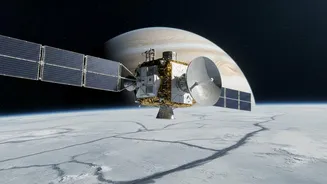
Launched in October 2024, the Europa Clipper is the largest interplanetary spacecraft NASA has ever built. As of August 2026, it is nearly two years into its 2.9-billion-kilometre voyage. After a successful gravity assist from Mars in early 2025, the spacecraft is now heading back toward our planet for a final gravitational slingshot in December 2026. This maneuver will give it the velocity needed to reach the Jupiter system by its scheduled arrival in April 2030. The long journey is necessary to get the massive probe to the outer solar system efficiently, setting the stage for its groundbreaking scientific investigation.
Searching for Habitability, Not Aliens
The headline's mention of studying “organisms” is ambitious; the mission's primary goal is more foundational. Europa Clipper is not designed to find life directly but to determine if Europa is habitable. It carries a sophisticated suite of nine scientific instruments to do just that. The mission will investigate three key requirements for life as we know it: liquid water, essential chemical elements, and an energy source. Instruments like an ice-penetrating radar will measure the thickness of the ice shell, while a magnetometer will confirm the ocean's existence and estimate its depth and salinity. Other tools, like spectrometers, will analyze the composition of the surface and any water vapor plumes that may erupt into space, looking for the chemical building blocks of life.
An Orbit Built for Survival
Studying Europa up close is a major challenge due to the intense radiation blasted from Jupiter’s powerful magnetic field. To protect its sensitive electronics, the Clipper will not orbit Europa directly. Instead, it will enter a long, looping orbit around Jupiter and perform nearly 50 close flybys of Europa over several years. During these brief but crucial encounters, the spacecraft will dip as low as 25 kilometers above the surface to gather detailed data before retreating to the relative safety of a higher orbit to transmit its findings back to Earth. This clever orbital design allows the mission to get a detailed global picture of the moon while minimizing damage from the harsh radiation environment.
What Comes Next?
Upon its arrival in 2030, Europa Clipper will begin its multi-year scientific survey. The data it collects will create the most detailed maps and characterizations of Europa ever assembled, painting a comprehensive picture of its surface geology, ice shell dynamics, and the nature of the ocean below. This information will be critical for understanding how ocean worlds form and evolve. While the Clipper itself won't be able to confirm the presence of life, its findings will pave the way for future missions. If Europa is indeed found to have all the necessary conditions for life, it would justify a future mission to land on the ice, drill down, and explore the mysterious ocean directly.