







A New Surprise from Shiv Shakti Point
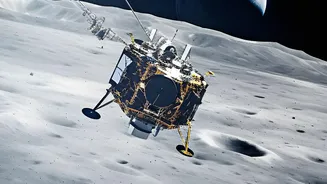
India's Chandrayaan-3 mission made history with its successful landing near the lunar south pole, a feat that continues to yield groundbreaking scientific returns. The latest discovery, coming from the Vikram lander at its 'Shiv Shakti Point' location,
peels back the surface of the Moon—literally. Scientists have identified that the lunar soil, or regolith, is not a uniform blanket of dust as one might assume. Instead, within the first 10 centimetres, there are three distinct layers, each with its own physical and thermal properties. This unexpected finding was made using data from one of Vikram's key instruments and provides a much more complex picture of the Moon's surface geology than previously observed in-situ.
The ChaSTE Instrument's Deep Dive
The hero of this discovery is the Chandra’s Surface Thermophysical Experiment, or ChaSTE. This instrument is a thermal probe, designed to be pushed into the lunar soil to measure its temperature and thermal conductivity. Equipped with ten individual temperature sensors, ChaSTE penetrated about 10 cm below the surface, sending back the first-ever direct profile of the topsoil's thermal behaviour at the lunar south pole. Its purpose is to understand how heat from the Sun travels through the Moon's topmost layer, which is crucial information for planning future missions, especially those searching for water ice.
Unpacking the Three Layers
The analysis, published in the journal npj Space Exploration, reveals a fascinating, fine-scale layering that was not expected. The very top layer, down to about 3 cm, is a highly porous, fluffy material with a porosity of around 80% and a low density. Below that, from 3 to 6 cm, is a middle layer that has a higher thermal conductivity, meaning it transfers heat more effectively. The bottom layer, from 6 to 10 cm, is denser still, with a bulk density more than double that of the surface layer, and it possesses an intermediate level of thermal conductivity. This detailed stratification points to a more dynamic and complex geological history at the landing site than previously known.
Why This Layering Is Significant
This discovery is more than just a geological curiosity; it has profound implications for future lunar exploration. Understanding the soil's properties, like its density, cohesion, and ability to conduct heat, is critical for designing rovers, habitats, and mining equipment. For instance, the data shows a dramatic temperature difference of about 73 degrees Celsius across just 10 cm of soil, with the layers responding differently to the Sun's heat. This could influence where future missions choose to place sensitive equipment or build habitats to take advantage of the soil's insulating properties just a few centimetres below the surface. The findings also provide an essential 'ground truth' that helps calibrate and refine data gathered from lunar orbiters.
Building on a Legacy of Discovery
This three-layer finding builds upon earlier analyses from the mission. An initial study identified a two-layer structure after Vikram performed a short 'hop' manoeuvre, where its engine firing blew away the uppermost soil at its new location. The latest analysis of the original, undisturbed landing spot has now revealed the complete, more complex three-layer profile. Scientists theorise that this layering may have been formed by successive impact events from nearby craters, which deposited material with different properties over time. This, along with other findings from the Pragyan rover's APXS instrument—which linked the site's soil chemistry to a rare lunar meteorite found on Earth—paints a picture of a geologically diverse and fascinating region. Each new piece of data from Chandrayaan-3 helps piece together the intricate history of the Moon's evolution.