



Cosmic Giants at the Dawn of Time
Imagine peering back over 13 billion years, to a time when the universe was less than 5% of its current age. You would expect to see the first, tentative steps of cosmic evolution: small, young galaxies just beginning to form. Instead, astronomers are
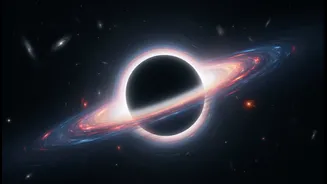
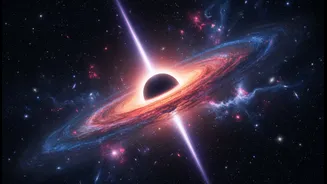
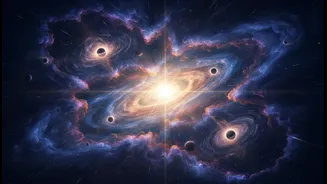
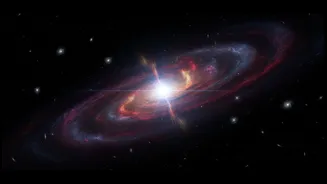
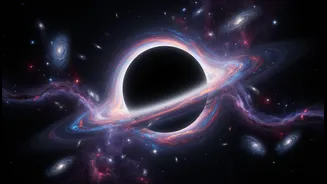
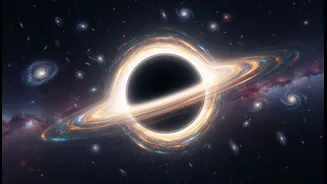
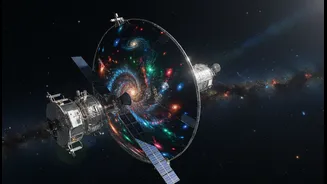
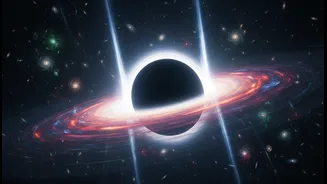
finding monsters. Recent discoveries have unveiled supermassive black holes, some with masses millions or even billions of times that of our Sun, lurking in the heart of galaxies when the universe was just a few hundred million years old. In early July 2026, the European Space Agency's Euclid telescope identified 31 of the oldest quasars—the intensely bright cores of galaxies powered by feeding black holes—roughly doubling the number known from that era and setting new distance records. These objects are not just far away; they are inexplicably huge for their age.
The 'Too Big, Too Soon' Problem
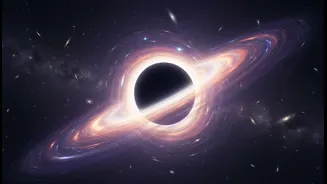
The existence of these ancient behemoths presents a major headache for astrophysicists, often called the 'too big, too soon' problem. For decades, the standard model of black hole formation was a story of gradual growth. It began with a 'light seed': a black hole formed from the collapse of a massive star, weighing maybe 100 times the mass of the Sun. Over billions of years, this seed would slowly feed on surrounding gas and dust, and merge with other black holes, eventually growing into the supermassive giants we see at the center of most large galaxies today, including our own Milky Way. The problem is that this process takes time. The newly discovered black holes simply did not have enough time to grow so large from such small beginnings.
When the Old Models Break
The traditional 'light seed' model relies on black holes growing at a steady, predictable rate. However, the sheer size of these early black holes breaks this timeline. It would be like finding a six-foot-tall toddler; you would know that something about your understanding of human growth was wrong. Some of these distant objects are so extreme that the black hole appears to be more massive than its entire host galaxy, a complete reversal of the relationship seen in the modern universe, where black holes typically account for only a tiny fraction of a galaxy's mass. This suggests that in some cases, the black hole may have formed before the galaxy around it, a paradigm-shifting idea that turns the story of galactic evolution on its head.
Meet the 'Heavy Seeds'
To solve this cosmic puzzle, scientists are now seriously considering alternative theories that were once on the fringe. The leading idea is the 'heavy seed' model. Instead of starting small, what if some black holes were born big? One version of this is the 'direct collapse black hole' theory. This scenario proposes that under the unique, pristine conditions of the early universe, a vast cloud of gas could collapse directly into a massive black hole—weighing tens of thousands to millions of times the mass of the Sun—skipping the star formation phase entirely. This would give these black holes a massive head start, allowing them to reach billion-solar-mass status in the short time available. Another theory suggests some smaller black holes could have grown at astonishing rates, feeding in chaotic, 'super-Eddington' frenzies that defy the normal limits of consumption.
What This Means for the Universe
This isn't just a debate about black holes; it's about the very architecture of the cosmos. If black holes can form first, they cease to be passive consequences of galaxy formation and become active agents. The immense energy released by a rapidly growing black hole could shape its host galaxy, either triggering bursts of star formation or blowing away the gas needed to form stars. Telescopes like the James Webb Space Telescope (JWST) and Euclid are not breaking the Big Bang theory, but they are filling in critical, and surprising, details about how the first structures emerged from the cosmic dark ages. These record-distance objects are time machines, giving us a direct view of the universe's chaotic and creative youth, forcing us to discard old assumptions and build a new, more complete picture of our cosmic origins.