





An Ocean Twice The Size of Earth's
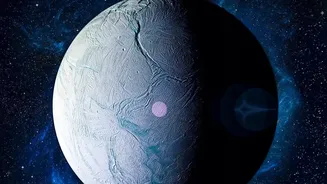
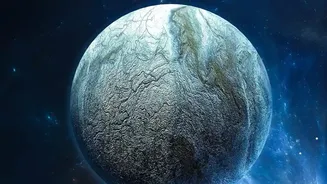
Beneath a shell of ice estimated to be 15 to 25 kilometers thick, scientists have gathered powerful evidence for a vast, liquid saltwater ocean. This ocean is thought to contain about twice as much water as all of Earth's oceans combined. The primary
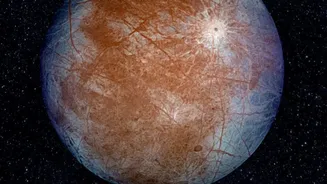
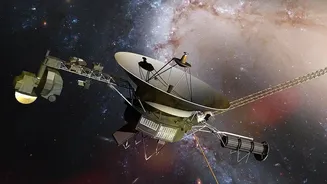
evidence came from NASA's Galileo spacecraft in the 1990s. As it flew past Europa, it detected a disruption in Jupiter's magnetic field, which strongly implied the presence of a global, electrically conductive fluid. The most logical explanation for this phenomenon is a massive body of salty water. Further observations of the moon's smooth, sparsely cratered surface, crisscrossed by enormous cracks and ridges, suggest a young and dynamic ice shell floating and shifting on the liquid layer below.
The Three Key Ingredients for Life
Astrobiologists generally agree that for life as we know it to exist, three key things are needed: liquid water, essential chemical elements, and a source of energy. Europa appears to be a prime candidate for having all three. The first ingredient, liquid water, is there in abundance. The second ingredient involves a specific chemical cocktail. Life on Earth depends on elements like carbon, hydrogen, nitrogen, oxygen, phosphorus, and sulfur (CHNOPS). Scientists believe these elements could be present on Europa, delivered by comet and asteroid impacts or churned up from the moon's rocky seafloor and cycled through the ocean. Recent observations have even suggested the presence of carbon dioxide originating from within the ocean, a crucial component for life.
An Engine to Power a Dark World
The third ingredient, energy, is perhaps the most fascinating piece of Europa's puzzle. Locked under a thick crust of ice, the ocean receives no sunlight, ruling out photosynthesis as we know it. Instead, the energy likely comes from two other sources. First, Europa is constantly squeezed and stretched by Jupiter's immense gravitational pull. This process, known as tidal flexing, generates enormous friction and heat within the moon's interior, keeping the ocean liquid and the core warm. Second, this internal heat could power hydrothermal vents on Europa's seafloor. On Earth, such vents are found in the deepest, darkest parts of our oceans, where they spew out chemical-rich superheated water, sustaining entire ecosystems of life completely independent of the sun.
A Complicated and Evolving Picture
The theory of a habitable Europa is not without its challenges. While the evidence for an ocean is strong, the nature of its seafloor is a subject of intense scientific debate. Some recent modeling in 2026 suggests that Europa's rocky interior may not be active enough today to create the kind of tectonic movement needed for powerful, life-sustaining hydrothermal vents. This research proposes that the moon's seafloor might be geologically quiet, which would limit the chemical energy available. Others argue that even without high-temperature volcanic vents, chemical reactions between the water and the rocky seafloor, a process called serpentinization, could still provide enough energy and nutrients to support microbial life. These debates highlight how much we still have to learn.
The Search Is On with Europa Clipper
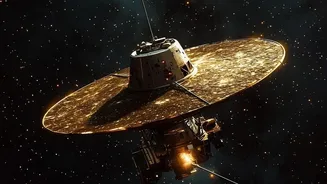
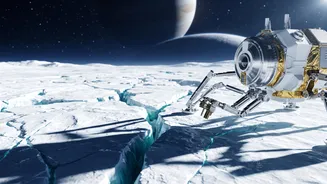
The only way to answer these questions is to go there. NASA's Europa Clipper mission, which launched in October 2024, is currently en route to the Jupiter system. After performing gravity-assist flybys of Mars and Earth, the spacecraft is set to arrive in orbit around Jupiter in April 2030. From there, it will perform approximately 49 close flybys of Europa, some as low as 25 kilometers above the surface. It is not a life-detection mission, but its main goal is to determine if Europa has the right conditions for life. Using a suite of nine advanced instruments, including ice-penetrating radar and spectrometers, it will characterize the ice shell, confirm the ocean's properties, and search for any plumes of water vapor that might be erupting into space, which could offer a direct sample of the ocean's contents.