
The Standard Story of the Universe
Until recently, our best understanding of the universe's evolution was a theory known as the Lambda-Cold Dark Matter (ΛCDM) model. Think of it as a cosmic recipe. It starts with the Big Bang, followed by a period where matter slowly and gradually came
together. In this model, the first galaxies to form were small and simple, like cosmic villages. Over billions of years, these small structures would merge and grow through a hierarchical, bottom-up process, eventually forming massive, complex galaxies like our own Milky Way. This framework has been incredibly successful, explaining many large-scale features of the cosmos. Scientists expected that when we looked back to the universe's first billion years, we'd see only these 'baby galaxies' in their infancy.
Webb’s Surprising Snapshot
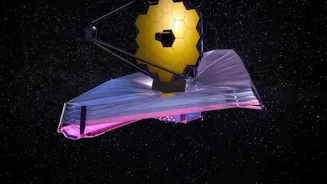
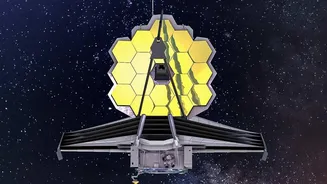
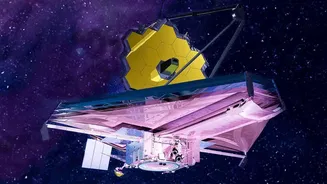
When JWST began sending back its first images, astronomers were stunned. Peering into the period just 300 to 700 million years after the Big Bang, the telescope didn't just find the expected 'baby galaxies'. Instead, it found cosmic monsters. Several observations have revealed galaxies that are surprisingly massive and mature for their age, some nearly as massive as the present-day Milky Way. Nicknamed 'universe breakers' by some, these objects appear far too developed, too quickly. It's like looking at a photograph of what should be a nursery and finding fully grown adults. These findings, published in major journals like Nature, created an immediate and exciting tension with our established models.
The 'Impossible Early Galaxy' Problem
The core of the issue is time. According to the standard ΛCDM model, there simply wasn't enough time for such massive galaxies to form so early in the universe's 13.8-billion-year history. The model predicted a much slower, more gradual accumulation of stars and mass. Finding galaxies with potentially a hundred billion stars at a time when the universe was only 5% of its current age was, as one astronomer put it, like finding 'a toddler weighing 100 kg'. This discrepancy suggests that either the first stars formed much more rapidly and efficiently than previously believed, or something about the fundamental physics of the early universe is different from what our models assume.
A Crack in the Cosmic Foundation?
This doesn't mean our entire understanding of cosmology is wrong, but it does suggest the ΛCDM model needs some significant revisions. Scientists are now exploring several possibilities. One idea is that star formation in the early universe was incredibly efficient, converting gas into stars at a much higher rate than we see today. Another possibility involves the very nature of dark matter, suggesting it might have behaved differently, allowing matter to clump together much faster after the Big Bang. A more recent and compelling theory is that some of these 'impossibly' large galaxies are actually an illusion. New analysis suggests that some of these bright, 'little red dots' might be powered by ravenous supermassive black holes at their centers, which make the host galaxy appear much brighter and more massive than it truly is. If these objects are removed from the sample, the remaining galaxies align better with predictions.
The Next Frontier for Cosmology
Rather than a crisis, this is a thrilling time for astrophysics. The tension created by JWST's data is exactly how science moves forward. The telescope has thrown a few 'curveballs', forcing a re-evaluation of long-held assumptions. Each new observation, whether it's an unusually massive galaxy, a complex merger of five galaxies, or an early black hole, provides a crucial piece of the puzzle. Researchers are now engaged in large-scale surveys, moving from studying a handful of strange objects to statistically analyzing hundreds of early galaxies to see which new theories hold up. The Webb telescope isn't just taking pictures; it's pushing theorists to build a more robust and accurate model of how everything we see came to be, from the first stars to the galaxy we call home.