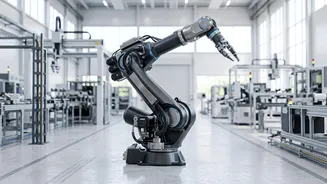







What is Eka Robotics?
Founded by MIT professor Pulkit Agrawal and former Google DeepMind researcher Tuomas Haarnoja, Eka Robotics is a Cambridge, Massachusetts-based startup developing what it calls general-purpose robots. The company’s mission is to move beyond single-purpose
industrial machines and create robots that can perform a wide variety of complex physical tasks, much like a human can. Their primary focus is on dexterous manipulation—the ability to handle objects with skill and precision, from packing delicate fruit to assembling server racks. This capability is crucial for automating trillions of dollars worth of manual labour still prevalent in logistics, manufacturing, and other sectors.
The Breakthrough 'Vision-Force-Action' Model
Eka’s core innovation is its 'Vision-Force-Action' (VFA) model. Unlike many robotics systems that rely primarily on vision (cameras) and language commands, Eka's robots also incorporate the sense of touch through force sensors in their custom-designed grippers. This allows the robot to 'feel' an object, adjusting its grip in real-time if something slips. This physical intuition, as the company calls it, is developed not by mimicking human demonstrations but through reinforcement learning in a simulated environment. Eka can generate thousands of hours of robot experience in minutes, allowing its AI to master physics and learn how to handle a vast array of objects and tasks without being explicitly trained on each one.
Superhuman Speed and a $150 Million Endorsement
The headline-making news is Eka's recent $150 million Series A funding round, co-led by prestigious venture capital firms Andreessen Horowitz (a16z) and F-Prime. This enormous investment, which values the young company at $1.45 billion, validates the significant investor appetite for 'physical AI'—intelligence that can perform work in the real world. Eka claims its robots can already achieve superhuman performance, picking objects at a rate of 1,500 per hour, more than double the human baseline of around 600, with over 95% accuracy. The same robot that can sort items can also perform more delicate tasks like screwing in a lightbulb or inserting wires, demonstrating the generality that investors find so compelling.
Scaling Deployments and Taking on the Real World
So, what does it mean to 'scale customer deployments'? With this new capital, Eka Robotics plans to move its technology from the lab to the factory floor. The company is already running early pilot programs with undisclosed industrial customers for tasks like 'pick-and-place' operations and wire handling. Scaling means expanding these pilots, taking on more customers, and proving that their robots can operate reliably for thousands of hours in real-world industrial environments, not just in controlled demonstrations. The funding will enable Eka to accelerate this commercial rollout, expand the range of tasks its AI can handle, and begin transforming industries like logistics and manufacturing at a larger scale.
The Road Ahead for Physical AI
While the technology is impressive, the true test for Eka Robotics is just beginning. The challenge lies in transitioning from successful pilots to durable, year-round performance on a busy assembly line or in a chaotic warehouse. Experts note that while the 'wow factor' is high, the system's reliability over long periods without failure is the ultimate metric for success in industrial automation. Competition is also heating up, with other startups exploring similar technologies. However, Eka's unique VFA model and the sheer scale of its Series A funding give it a powerful head start. Its success could pave the way for a new wave of automation, where general-purpose robots work alongside humans, fundamentally reimagining the nature of physical work.