

The Universe We Thought We Knew
The standard model of cosmology has long painted a clear picture of cosmic evolution. After the Big Bang, the universe was a formless sea of gas. Over hundreds of millions of years, gravity began pulling this material into small, clumpy, and irregular
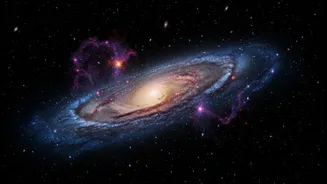
protogalaxies. According to this theory, these messy toddler galaxies would then collide and merge over billions of years, gradually settling into the majestic, well-ordered spiral and elliptical galaxies we see in our cosmic neighbourhood today. This process was thought to be slow and incremental, like building a city one brick at a time. The elegant spiral arms of a galaxy like our own Milky Way, for instance, were considered a hallmark of maturity, a structure that could only form after a long period of cosmic settling. This orderly, bottom-up model of galaxy formation has been the foundation of astrophysics for years, but new evidence is beginning to shake its very foundations.
A Pattern of Surprising Maturity
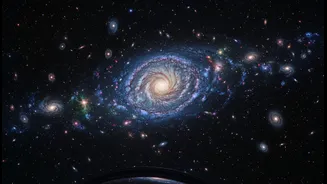
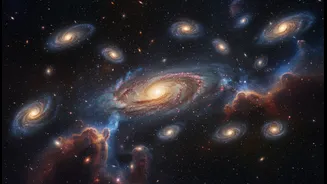
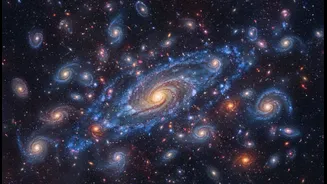
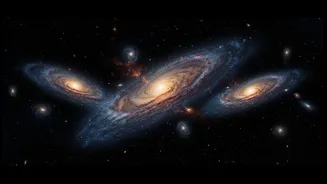
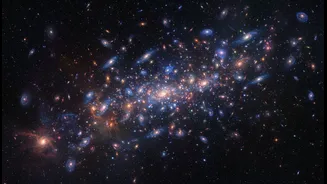
The James Webb Space Telescope (JWST) is peering back to the dawn of time, and it is not seeing the chaotic, undeveloped cosmos scientists expected. Instead, it is finding a consistent pattern of galaxies that are far too massive, bright, and structured for their age. Some galaxies spotted within the first 500 to 800 million years after the Big Bang appear to be as massive as our own Milky Way, a feat that should have taken billions of additional years to achieve. In another instance, astronomers observed a complex collision of at least five galaxies occurring just 800 million years after the Big Bang, a type of intricate interaction thought to be rare so early on. This recurring theme of early maturity suggests that the universe was in a hurry to build complex structures, challenging our fundamental timeline of cosmic evolution. It's as if we looked at a photograph of a one-year-old child and found they already had the skeleton of a full-grown adult.
The Indian 'Alaknanda' Discovery
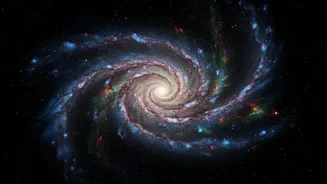
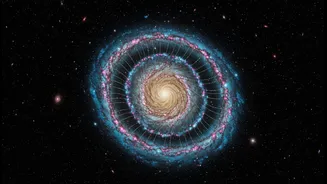
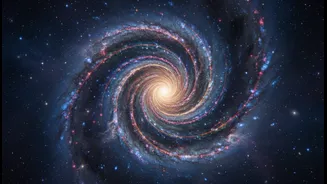
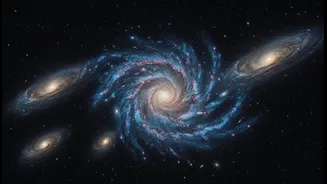
A groundbreaking discovery by Indian astronomers has provided a spectacular example of this early maturity. Using JWST data, Rashi Jain and Yogesh Wadadekar of the National Centre for Radio Astrophysics in Pune discovered a stunningly well-formed spiral galaxy from when the universe was just 1.5 billion years old. Named 'Alaknanda' after a headstream of the Ganga river, this galaxy features a clear disc and symmetric spiral arms, closely resembling our own Milky Way. Finding such a 'grand-design' spiral so early directly contradicts the belief that galaxies of this era were mostly small and irregular. The discovery of Alaknanda, which is forming stars at a rate 20 to 30 times higher than the Milky Way, suggests that the processes for creating large, organised galaxies can happen much faster than models predicted. This finding by Indian scientists is a major milestone, providing a key piece of the puzzle and forcing a global rethink of how quickly the cosmic dawn gave way to organised structures.
Puzzles in Galactic Form
The surprises go beyond just size and shape. One of the most telling signs of a mature galaxy is a 'bar'—a dense, linear structure of stars and gas that funnels material to the galactic centre. These bars were thought to be a recent evolutionary feature, yet JWST has found distinct barred spiral galaxies that existed when the universe was only two billion years old. The existence of these structures so early suggests the internal physics of galaxies stabilised much more quickly than believed. In another baffling discovery, astronomers found a massive galaxy from the same early period that showed no signs of rotation at all. Normally, a galaxy stops spinning only after a long history of mergers that cancel out its momentum. Finding a 'dead' or non-rotating galaxy so young is like finding a fossil where there should be a developing embryo, presenting another deep puzzle for cosmologists to solve.
Rewriting Our Cosmic Origin Story
These discoveries are more than just cosmic curiosities; they represent a fundamental challenge to the standard model of cosmology. The consistent presence of 'universe-breakers'—galaxies that appear too big, too structured, and too mature for their age—forces scientists to ask profound questions. Does star formation happen in dramatic bursts that make galaxies appear more massive than they are? Or did galaxies simply grow much faster than our theories allow? Some scientists suggest the observations might even point to a need for new physics. The answer could involve revising our understanding of dark matter, the mysterious substance that provides the gravitational scaffolding for galaxies, or even modifying our model of how fast the universe expanded in its earliest moments. Whatever the solution, the JWST has opened a new chapter in astronomy, one where old assumptions are being discarded and our origin story is being rewritten with every new image.