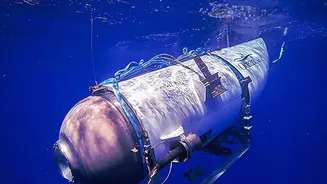







The deep ocean is the most alien environment on Earth, a world of total darkness and unimaginable force. Surviving here, let alone exploring, requires engineering marvels. At the heart of this endeavor is the titanium pressure sphere.
An Ocean of Pressure
To understand the
need for such specialized equipment, one must first appreciate the sheer hostility of the deep sea. For every 10 meters you descend, the pressure increases by one atmosphere. At the bottom of the Mariana Trench, nearly 11,000 meters down, the pressure is over 1,000 times that at sea level. This equates to about 16,000 pounds per square inch (PSI), or the weight of 100 adult elephants pressing on your head. Under such immense, uniform force, most materials would be instantly crushed. A conventional submarine hull would buckle and implode long before reaching these depths. This environment, known as the hadal zone, demands a solution that can withstand forces that are, for all practical purposes, absolute.
Titanium: The Champion of Materials
Not all metals are created equal, especially when it comes to deep-sea survival. While high-strength steel is used for many submersibles, the extreme depths of the trenches call for something better: titanium. Specifically, alloys like Ti-6Al-4V are prized for several key reasons. First is its incredible strength-to-weight ratio; it's as strong as many steels but about 45% lighter. This is critical for buoyancy and maneuverability. Second, titanium possesses an exceptional resistance to corrosion, particularly from saltwater, which is relentlessly aggressive toward most other metals. It forms a protective oxide layer, essentially armoring itself against the environment. This combination of strength, low density, and corrosion resistance makes it the undisputed champion for deep-diving pressure hulls.
The Power of the Sphere
The choice of material is only half the battle; the geometry of the crew compartment is just as crucial. The perfect shape for resisting uniform external pressure is a sphere. Unlike a cube or cylinder, which has corners and flat surfaces where stress can concentrate, a sphere distributes the crushing force of the water evenly across its entire surface. This means there are no inherent weak points. Any inward force is perfectly counteracted by the structure's inherent shape, channeling the stress around the crew compartment rather than allowing it to build up at a specific point. This principle is why soap bubbles and planets are spherical—it's nature's most stable and efficient shape for handling uniform forces.
A Feat of Precision Engineering
Creating a flawless titanium sphere is a monumental engineering challenge. These spheres are typically manufactured from two perfectly machined hemispheres made from forged titanium. The forging process itself often happens in a vacuum to ensure the material's purity and strength. The two halves are then meticulously welded together. This weld is one of the most critical and scrutinized parts of the entire submersible, as any imperfection could become a catastrophic point of failure under pressure. The tolerances are incredibly low, and the entire structure must undergo rigorous testing, often being subjected to pressures even greater than those it will face in the ocean to ensure a massive safety factor. This difficult and expensive manufacturing process is why these spheres represent the pinnacle of materials science and structural engineering.