



The Invisible Danger in a Sealed Can
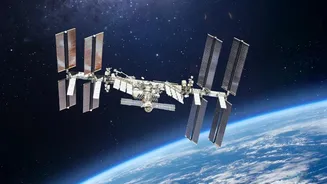
On the International Space Station (ISS), you can't just open a window for fresh air. Every breath an astronaut takes releases carbon dioxide. Equipment off-gasses trace amounts of chemicals like ammonia and acetone. Without constant management, this
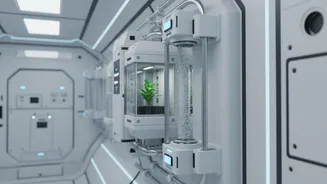
buildup would quickly make the air unbreathable, leading to serious health issues. The Environmental Control and Life Support System (ECLSS) is the multi-layered marvel of engineering that prevents this. It's an advanced recycling plant for the atmosphere, ensuring the air remains safe and Earth-like for long-duration missions.
Scrubbing the Air of Carbon Dioxide
The most immediate threat is the CO2 exhaled by the crew. On Earth, plants handle this, but in space, technology must do the job. The ISS primarily uses a system called the Carbon Dioxide Removal Assembly (CDRA). This unit pulls cabin air through beds of a porous, crystal-like material called zeolite. These beds act like a molecular sieve, trapping CO2 molecules while letting oxygen and nitrogen pass through. The system works in a clever cycle: while one set of zeolite beds is absorbing CO2 from the cabin air, another set is being heated and exposed to the vacuum of space, which purges the captured CO2 overboard. This regenerative process allows the system to operate continuously with minimal resupply.
Tackling Trace Contaminants
Beyond CO2, hundreds of other potentially harmful chemical vapours can accumulate inside the station. These are removed by the Trace Contaminant Control System (TCCS). This system functions like a high-tech filter. Air first passes through a bed of activated charcoal, which physically adsorbs a wide range of organic compounds. Then, a high-temperature catalytic oxidizer essentially burns the remaining impurities, converting them into harmless substances like water and CO2 (which is then removed by the CDRA). This two-step process is crucial for preventing the long-term health effects that could arise from inhaling even low levels of toxic gases.
Generating Fresh, Breathable Oxygen
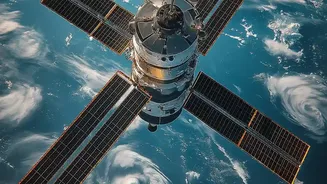
With contaminants removed, the system must also replenish the oxygen astronauts consume. The primary method for this on the ISS is electrolysis, performed by the Oxygen Generation System (OGS). This system takes reclaimed water—recycled from sources like crew urine and cabin humidity—and passes an electric current through it. The electricity, generated by the station's massive solar arrays, splits the water (H2O) molecules into their constituent parts: breathable oxygen and hydrogen gas. The oxygen is released into the cabin atmosphere, while the hydrogen is safely vented into space or, in some newer systems, used to create more water.
A Network of Redundancy and Monitoring
The ECLSS is not one single machine but a network of interconnected systems with multiple backups. For example, both the US and Russian segments of the station have their own oxygen generation systems, the OGS and the Elektron, respectively. There are also solid fuel oxygen generators—often called 'oxygen candles'—that can be used in an emergency. The entire atmosphere is constantly monitored by a suite of sensors that check for pressure, temperature, humidity, and the levels of various gases. This continuous analysis ensures that if any part of the system falters or a leak occurs, the crew is alerted immediately, safeguarding their health around the clock.