



What is a Signature Whistle?
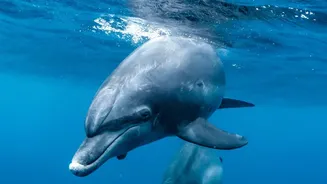
In the vast, often murky, underwater world, staying connected is a matter of survival. Dolphins have mastered this through a remarkable form of communication: the signature whistle. This isn't just a random chirp or squeak; it's a learned, individually
distinct vocal label that a dolphin develops within its first year of life. Much like human infants babble before they speak, dolphin calves experiment with different sounds before settling on a stable, unique whistle that will identify them for the rest of their lives. This whistle's specific frequency and pattern—its unique melodic contour—acts as an acoustic fingerprint. For decades, researchers tracking individual dolphins have found that this whistle remains remarkably consistent, serving as a constant identifier that is recognisable to other dolphins across great distances.
The Science of a Dolphin's 'Name'
The idea that these whistles are like names isn't just a charming analogy; it's backed by rigorous scientific research. Pioneering studies, particularly by researchers like Dr. Stephanie King and Dr. Vincent Janik at the University of St. Andrews, have provided conclusive evidence. In landmark experiments, scientists used underwater speakers to play back recorded signature whistles to wild dolphins. The results were astonishing. When a dolphin heard a recording of its own signature whistle, it would often respond by calling back with the very same whistle, as if to say, 'Yes, that's me. I'm here'. However, when they heard the whistles of unfamiliar dolphins or other familiar pod members, they did not respond in the same way. This referential communication—using a specific sound to refer to a specific individual—is a cognitive feat rarely seen outside of humans.
More Than Just Identification
Signature whistles are about far more than just broadcasting identity; they are the glue that holds complex dolphin societies together. Dolphins live in what is known as a 'fission-fusion' society, where groups constantly split apart and merge. In this fluid social environment, being able to find and reconnect with specific individuals is crucial. A mother can call to her calf, and male dolphins that form long-term alliances can find each other after being separated. Scientists have observed that dolphins will copy the signature whistle of a close associate, essentially 'calling their name' to initiate a reunion. These calls can travel up to 20 kilometres depending on water conditions. Interestingly, researchers also discovered that mother dolphins alter the pitch of their signature whistles when communicating with their calves, a phenomenon similar to the 'motherese' or baby-talk used by human caregivers.
A Glimpse into an Advanced Mind
The use of signature whistles offers a profound insight into the complexity of the dolphin mind. This isn't an innate, instinctual call like a bird's alarm cry. It is a learned vocalization. A young dolphin listens to the members of its community and invents a whistle that is deliberately different from its close associates, carving out its own acoustic identity. Furthermore, dolphins can extract this identity information from the whistle's melodic shape alone, independent of the unique voice features of the caller. This ability to separate a 'name' from the voice saying it is a level of abstract thought that was once believed to be uniquely human. This complex social toolkit, complete with names, vocal learning, and targeted communication, suggests a high degree of self-awareness and social intelligence that continues to challenge our understanding of non-human animals.