



The Unforgiving Lunar Night
Exploring the Moon is not for the faint of heart, or for the poorly insulated. During the long lunar night, temperatures can plummet to below minus 173 degrees Celsius near the equator. In the permanently shadowed craters of the lunar south pole—a region
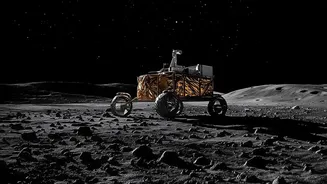
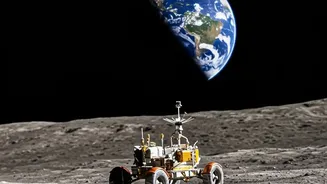
of intense scientific interest—it gets even colder, reaching a staggering minus 250 degrees Celsius. At these temperatures, the sensitive electronics that form the brain and senses of a rover would freeze and crack. Batteries would lose their ability to hold a charge, and the mission would come to an abrupt and icy end. This is precisely what happened to India's heroic Chandrayaan-3 Pragyan rover; it was designed for a single lunar day and fell silent as the night set in, its mission complete. For humanity to establish a sustained presence on the Moon, rovers need a way to survive this brutal cold.
A Warm Heart of Plutonium
The solution comes in a surprisingly small package: the Radioisotope Heater Unit, or RHU. These devices are the unsung heroes of deep space exploration, acting like personal, long-lasting space heaters for vital rover components. Unlike solar panels, which are useless in the dark, RHUs provide a constant, reliable source of heat for decades. Each unit is about the size of a C-cell battery and contains a tiny pellet of a radioactive material, most commonly Plutonium-238. It is important to distinguish these from Radioisotope Thermoelectric Generators (RTGs), which are much larger systems designed to generate electricity. RHUs are specialists; their sole job is to produce heat, ensuring a rover’s internal temperature stays within operational limits, no matter how cold it gets outside.
The Science of Steady Warmth
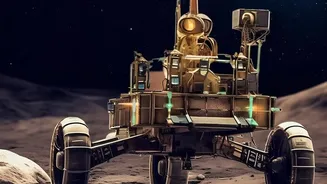
The genius of the RHU lies in its simplicity. It has no moving parts and requires no electrical input. The heat is generated by the natural process of radioactive decay. As the Plutonium-238 pellet slowly decays, it releases a steady, predictable amount of heat—about one watt per unit. This isn't a nuclear reaction like in a power plant; it’s a gentle, consistent process. Mission planners strategically place several of these RHUs around a rover's most vulnerable systems, such as the battery compartment, computers, and scientific instruments. This targeted warmth prevents freezing, allowing the rover to 'hibernate' through the lunar night and wake up when the sun returns. This technology has been a cornerstone of space exploration, used in missions from the Apollo era to China’s Chang'e-4 rover, which has been operating on the far side of the Moon for years thanks to its RHUs.
Unlocking the Moon's Final Frontiers
Surviving the night does more than just extend a mission's lifespan; it fundamentally changes the scope of what's possible on the Moon. It allows for long-term scientific studies, observing how the lunar environment changes over time. More importantly, it unlocks access to the most compelling and challenging destinations on the lunar surface: the permanently shadowed regions (PSRs) at the south pole. These craters, which haven't seen sunlight in billions of years, are believed to hold vast deposits of water ice. This ice is a critical resource for future human exploration, as it could be converted into drinking water, breathable air, and rocket propellant. Missions like NASA’s planned Artemis program are targeting these very regions, and the ability to operate rovers there for extended periods is entirely dependent on technologies that can withstand the extreme and persistent cold.
India's Quest for Lunar Night Survival
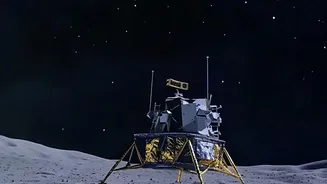
After the landmark success of Chandrayaan-3, the Indian Space Research Organisation (ISRO) is setting its sights on the next great challenge: surviving the lunar night. While Chandrayaan-3 fulfilled its mission objectives within a single lunar day by design, future ambitions require longer-lasting technology. ISRO is actively developing the necessary technologies to enable its future rovers to endure the harsh lunar freeze. This is a critical step for upcoming missions like the Lunar Polar Exploration Mission (LUPEX), a joint venture with Japan's space agency (JAXA) planned for the late 2020s. The LUPEX mission specifically aims to explore the lunar polar region and will need to demonstrate lunar night survival technologies to conduct its search for water ice. Mastering this capability will cement India's position as a major player in the new era of sustained lunar exploration and resource utilization.