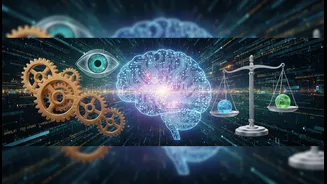









The Limits of the Perfect Prompt
Not long ago, the 'prompt engineer' or 'AI whisperer' was hailed as the definitive job of the future. The logic was simple: those who could best instruct generative AI tools would hold a significant advantage. Companies scrambled to hire for this skill,
and online courses promising to teach the art of the perfect prompt proliferated. However, this initial hype has collided with a more complex reality. Businesses quickly discovered that while a well-crafted prompt can produce impressive results for a specific task, it is not a substitute for strategic thinking. Relying solely on prompt-writing skills is like knowing how to ask a calculator a question without understanding the mathematical principles behind the answer. It's a useful tactic, but not a strategy. The skill is also becoming automated, with AI models themselves getting better at interpreting vague instructions and even refining prompts on their own.
The New Pillars of AI Fluency
Recognising the limitations of prompt-centric skills, a broader and more robust definition of AI literacy is emerging. This new model is less about talking to the AI and more about thinking with it. The focus has shifted to a suite of higher-order capabilities. Experts now point to concepts like 'context engineering', which involves designing the entire information environment an AI operates in, not just a single instruction. This means structuring data, defining goals, and understanding how to provide the right context for the AI to perform complex, multi-step tasks reliably. Beyond the technical, this expanded literacy includes crucial human skills: critical thinking, ethical judgment, and domain expertise. The most valuable employee is no longer the one who can write the best prompt, but the one who can critically evaluate the AI's output, spot biases, and apply the technology ethically and effectively to solve real business problems.
Remaking the Modern Workplace
In offices across India and the world, this shift is changing how companies approach training and talent development. Leading organisations are moving beyond one-off 'ChatGPT for beginners' workshops and investing in comprehensive AI training that is integrated with business strategy. These programs focus on equipping leaders and employees to identify strategic opportunities for AI, manage implementation risks, and foster a culture of responsible AI use. The goal is not to turn every employee into a coder, but to create a workforce that can collaborate effectively with AI systems. This means training marketing teams to use AI for data analysis while understanding privacy implications, or teaching project managers to use AI for workflow optimisation while maintaining human oversight. Companies are realising that employees who are highly proficient with AI are more engaged, but also have a higher intent to leave if their skills are not utilised, making strategic upskilling a crucial retention tool.
Educating the Next Generation in India
This evolution is mirrored in the education sector, where the push for AI literacy is gaining significant momentum in India. Aligned with the National Education Policy (NEP) 2020, there is a major initiative to integrate AI and computational thinking into school curricula, starting from as early as the third grade. The Central Board of Secondary Education (CBSE) and other boards have already introduced AI as a subject and are expanding these programs. Crucially, this is not just about teaching coding. The new curriculum framework emphasizes developing a foundational understanding of what AI is, how it works, its real-world applications, and the ethical considerations involved. The aim is to cultivate a generation that is not just a consumer of AI technology, but a cohort of creators, critical thinkers, and responsible innovators.
The Human Element Remains Key
Ultimately, the expansion of AI literacy beyond prompt engineering is a recognition that technology is a powerful amplifier, but it lacks human judgment, wisdom, and context. The most sought-after skills in an AI-augmented world are increasingly human-centric: creativity, strategic problem-solving, emotional intelligence, and ethical reasoning. AI can process vast amounts of data and identify patterns, but it cannot understand a company’s culture, a customer's unspoken need, or the ethical implications of a decision. Therefore, the future of work isn't about humans being replaced by machines, but about humans augmented by them. True AI literacy empowers individuals to use these powerful tools to enhance their own intelligence, not to outsource their thinking.