

What Exactly Is a Super-Earth?
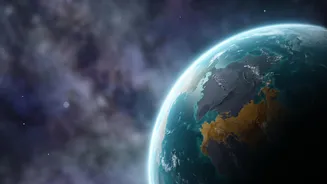
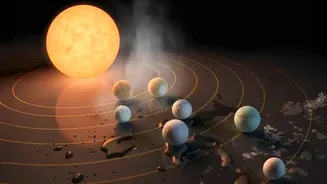
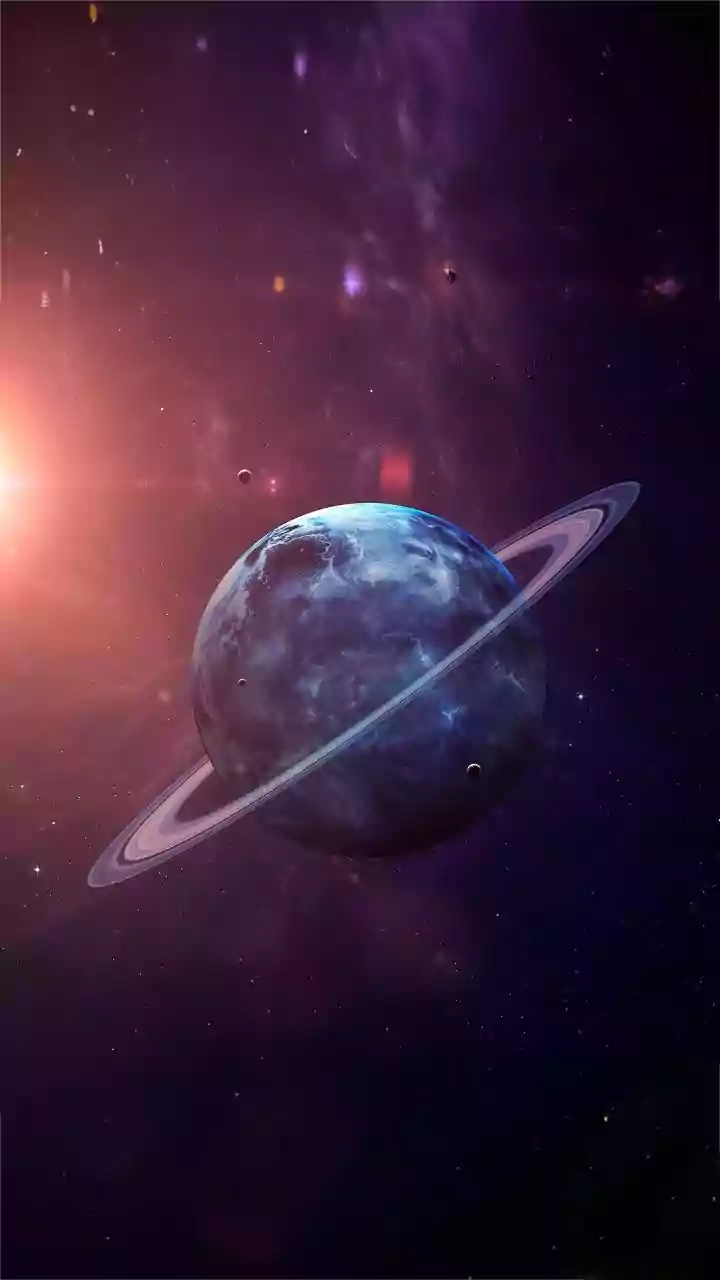
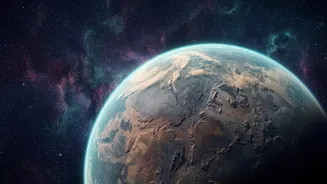
Before we dive into the latest discovery, let's clarify what scientists mean by a 'super-Earth'. Imagine a planet that's more massive and larger than our own, but not as big as gas giants like Neptune or Jupiter. These worlds are one of the most common
types of exoplanets found in our galaxy, yet we don't have one in our own solar system to study up close. This makes them objects of intense scientific curiosity. They occupy a fascinating middle ground: are they oversized rocky worlds like Earth, or are they more like 'mini-Neptunes' with thick, crushing atmospheres? The answer likely depends on the specific planet, and finding out which is which is a key goal for astronomers. Because of their size, they are easier to spot and study than Earth-sized planets, making them prime targets for telescopes like the JWST.
The Power of Infrared Vision
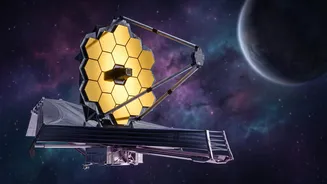
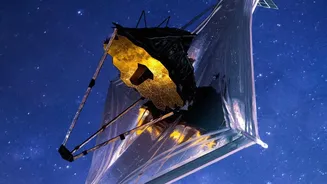
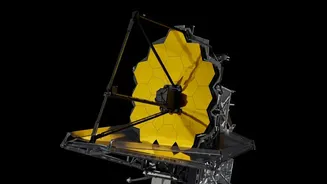
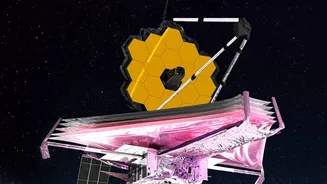
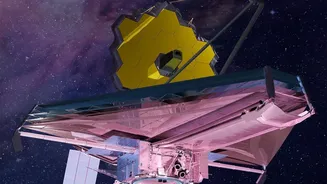
The James Webb Space Telescope is an engineering marvel, designed specifically to see the universe in infrared light. This is crucial for studying exoplanets. When a planet passes in front of its star from our point of view, a tiny fraction of the starlight filters through the planet's atmosphere. Different chemical elements and molecules in that atmosphere absorb specific wavelengths of light. JWST's highly sensitive instruments, like its Mid-Infrared Instrument (MIRI), can analyse this filtered starlight to create a 'spectrum'. This spectrum acts like a chemical fingerprint, revealing which molecules are present. It's through this technique, called transmission spectroscopy, that astronomers can identify gases like methane, carbon dioxide, and, most excitingly, water vapour.
A Steamy and Surprising Atmosphere
Recent observations have focused on intriguing super-Earths like GJ 1214 b and K2-18 b. For years, GJ 1214 b was a mystery, shrouded in thick clouds or haze that older telescopes couldn't penetrate. But with Webb's ability to peer through this veil, scientists have found compelling evidence that its atmosphere is likely composed primarily of water vapour. Similarly, studies of K2-18 b have identified not just water vapour but also methane and carbon dioxide. This chemical cocktail is significant because these are the kinds of gases we associate with life-supporting atmospheres. However, the story isn't as simple as 'water equals life'. The 'secret' the JWST is uncovering is often more complex and cautionary.
The 'Secret' Isn't Life, It's Geology
The headline 'water found' often sparks images of blue oceans and Earth-like landscapes. However, the reality JWST is revealing is far more alien. For many of these super-Earths, the sheer amount of water vapour detected, combined with their high temperatures and pressures, paints a picture of 'steam worlds' or 'Hycean' (hydrogen and ocean) planets. For example, on a planet like TOI-270 d, scientists speculate the water may exist as a single, globe-spanning ocean under a dense, hydrogen-rich atmosphere, with surface temperatures potentially exceeding 100 degrees Celsius. In such a state, the water would be a hot, dense fluid unlike anything on Earth. So, the secret isn't about little green men, but about a planetary geology and climate system radically different from our own.
Redefining the Search for Habitable Worlds
These discoveries force us to be more precise in our search for life. Finding water is an incredible first step, but context is everything. A planet can have abundant water vapour and still be completely inhospitable. For example, some super-Earths may not have a solid surface at all, instead transitioning from a dense gas atmosphere directly into a liquid layer. Other planets, like WASP-18 b, are so hot that most water molecules are torn apart by the intense heat and radiation. The fact that Webb can detect even the faint signatures of the remaining water is a testament to its power. Each new observation helps scientists refine their models of how planets form and what conditions are truly necessary to create a habitable environment. It's a shift from simply finding the ingredients for life to understanding the planetary recipe.