




The Allure of Methane
In the grand cosmic detective story of searching for life beyond Earth, methane has long been a prime suspect. On our own planet, a huge amount of atmospheric methane is produced by living organisms, from microbes in wetlands to cows in fields. Because
methane breaks down relatively quickly when exposed to starlight, its persistent presence in a rocky planet's atmosphere could imply that something is constantly replenishing it. This makes it a tantalizing potential biosignature—a chemical fingerprint of life. For years, astronomers believed that finding methane alongside carbon dioxide, but with very little carbon monoxide, on a distant, rocky world would be a powerful indicator of biological processes at work, much like they are on Earth. This simple but powerful idea has guided much of our search for inhabited worlds.
Enter the Warm Neptunes
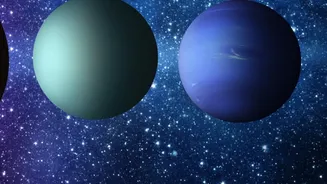
The universe, however, is rarely simple. As our telescopes have become more powerful, we've discovered thousands of exoplanets, many of which fall into categories unlike anything in our own solar system. One of the most common types are 'sub-Neptunes' or 'warm Neptunes'. These are planets larger than Earth but smaller than Neptune, often orbiting their stars much more closely than our own ice giants do. A prominent example that has captured scientific attention is K2-18 b, a planet 8.6 times the mass of Earth orbiting a star 120 light-years away. These worlds are often described as having the potential for hydrogen-rich atmospheres and, in some cases, vast water oceans, earning them the nickname 'Hycean' planets. Their commonness across the galaxy makes them crucial targets in the study of planetary formation and potential habitability.
A Complicated Chemical Recipe
This is where our understanding begins to shift. Thanks to the unparalleled power of the James Webb Space Telescope (JWST), scientists have been able to peer into the atmospheres of these distant worlds with incredible detail. Observations of planets like K2-18 b and the 'warm Jupiter' WASP-80 b have indeed confirmed the presence of methane. However, the unique conditions on these warm, large planets offer a way to produce methane without any life at all. On a world with a hydrogen-rich atmosphere and potentially a very hot, liquid water ocean or even a magma ocean, high temperatures and pressures can drive chemical reactions that are not common on Earth. Geochemical processes, such as the interaction between water and hot rock (a process known as serpentinization), can release large quantities of hydrogen, which then reacts with carbon to form methane abiotically—no microbes required. The vigorous mixing in their hot atmospheres can also dredge up chemicals from deep within the planet, further altering the chemical signature we observe.
Redefining the Search for Life
This doesn't mean these worlds are barren, but it fundamentally changes the rulebook. The presence of methane on a warm Neptune or sub-Neptune can no longer be seen as a straightforward hint of life. Instead, it is more likely an indicator of interesting geology and atmospheric chemistry. Scientists now understand that context is everything. Rather than looking for a single 'smoking gun' molecule, they must analyze the entire atmospheric inventory. The key might be to look for a specific combination of gases that is hard to explain through geology alone. For example, some researchers are now focused on detecting dimethyl sulphide (DMS), a gas that, on Earth, is produced exclusively by marine life. Tentative hints of DMS were found at K2-18 b, though this detection is still under intense debate and requires much more data to confirm. This discovery forces a more nuanced approach, pushing scientists to develop more sophisticated models to distinguish between a geologically active planet and a biologically active one.