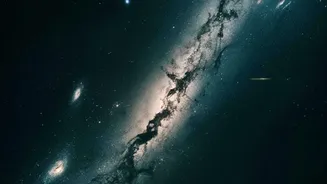



For decades, we’ve been told the universe is about 13.8 billion years old. But what if that number was completely wrong? A provocative new theory suggests our cosmos might be nearly twice as old, forcing us to rethink everything we know.
Our Universe’s Official Story
For most of modern
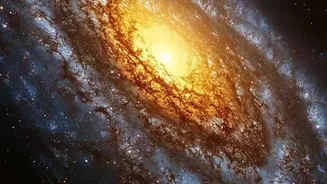
science, the story of our universe has a clear beginning. The prevailing theory, known as the Lambda-CDM model, tells us that everything began with the Big Bang. From that single, explosive moment, space has been expanding and cooling down. By measuring the rate of this expansion and tracing it backward, astronomers have confidently calculated the age of the cosmos to be approximately 13.8 billion years. This age is a fundamental pillar of cosmology, underpinning our understanding of how stars, galaxies, and indeed everything we see, came to be. It has been tested and verified through multiple lines of evidence, from the cosmic microwave background radiation — the faint afterglow of the Big Bang — to the distribution of galaxies across vast distances. For years, this number has been the bedrock of our cosmic timeline.
The James Webb Telescope's Surprise
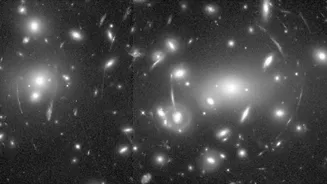
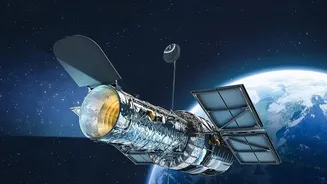
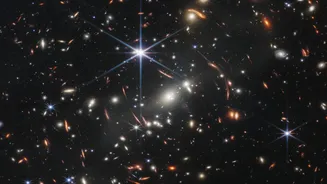
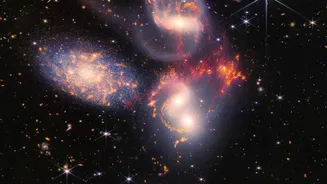
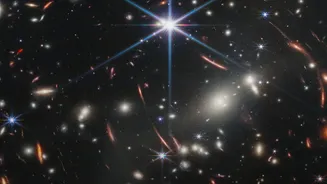
Then came the James Webb Space Telescope (JWST). With its unprecedented power to peer deep into the cosmic dawn, JWST began spotting things that didn't quite fit the established narrative. It found several galaxies that, based on their distance, must have existed just 500 to 700 million years after the Big Bang. The problem? These galaxies were shockingly mature. They appeared to be as massive and developed as galaxies that should have taken billions of years to form, like our own Milky Way. This has been dubbed the 'impossible early galaxy problem'. Within the standard 13.8-billion-year model, there simply doesn't seem to be enough time for such complex structures to emerge so early. It's like finding a fully grown oak tree in a field where you only planted a seed last week.
A Radical New Timeline
In response to this puzzle, some scientists are proposing a radical solution: what if the timeline itself is wrong? One of the most talked-about alternatives comes from Rajendra Gupta, a physics professor at the University of Ottawa. He suggests the universe is not 13.8 billion years old, but a staggering 26.7 billion years old. By nearly doubling the age of the cosmos, Gupta's model solves the 'impossible early galaxy' problem instantly. An extra 13 billion years provides more than enough time for even the earliest observed galaxies to form, grow, and mature into the complex structures the JWST is seeing. It’s a bold and elegant solution, but it requires us to fundamentally rethink how we interpret the signals we receive from the distant universe.
Old Ideas, New Purpose
Gupta’s model achieves this revised age by blending the standard model with older, once-discarded ideas. A key component is the 'tired light' theory. This hypothesis, first proposed by Fritz Zwicky in 1929, suggests that light loses energy as it travels over cosmic distances. In the standard model, the redshift of distant galaxies (where light shifts towards the red end of the spectrum) is seen purely as evidence of the universe's expansion. Gupta’s hybrid model suggests redshift is a combination of both expansion and tired light. By incorporating this idea, along with a theory of evolving 'coupling constants' that govern forces between particles, he can reinterpret the data and stretch the universe's timeline without contradicting key observations. It’s a complex recalibration of our cosmic clock, using a mix of new and old physics.
The View From Mainstream Science
It is crucial to note that this alternative cosmology is far from being accepted by the scientific community. The vast majority of cosmologists remain confident in the Lambda-CDM model and the 13.8 billion-year age. For most, the idea of tired light has been largely discredited for decades, and they believe there are other, less extreme ways to explain JWST’s surprising findings. These could involve tweaking our understanding of how quickly the first stars formed or how black holes influenced early galaxy growth. Gupta's work is seen as an interesting thought experiment, but most scientists are waiting for much more direct and compelling evidence before they consider abandoning a model that has successfully explained so much about our universe for so long. For now, it remains an intriguing outlier.