
A World of Epic Seasons
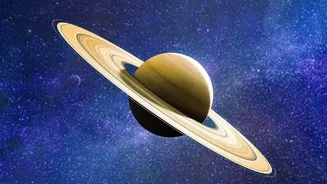
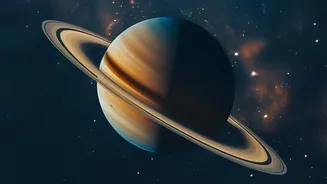
Like Earth, Saturn has seasons, but on a scale that is difficult to comprehend. The planet is tilted on its axis by about 27 degrees, very similar to Earth's 23.5-degree tilt. However, Saturn takes a leisurely 29.5 Earth years to complete one orbit around
the Sun, meaning each of its four seasons lasts for more than seven years. This slow-motion seasonal cycle brings about dramatic changes to the planet and its iconic rings. Right now, scientists are eagerly watching as Saturn heads towards its next equinox, a special time when the Sun shines directly over the planet's equator. This grand event, set to occur in May 2025, is causing fascinating changes that telescopes like Hubble are perfectly positioned to capture.
The Incredible Shrinking Shadow
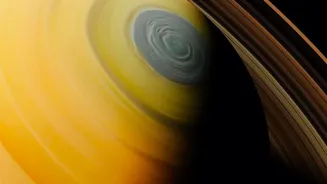
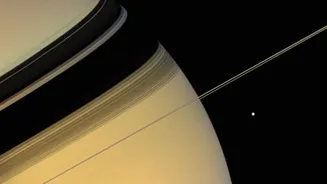
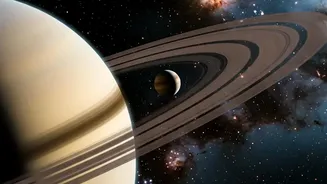
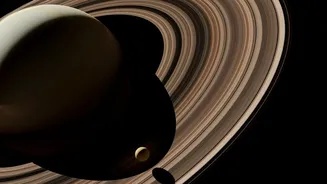
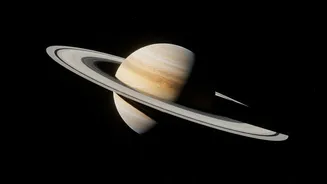
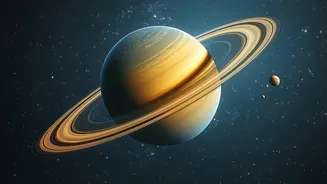
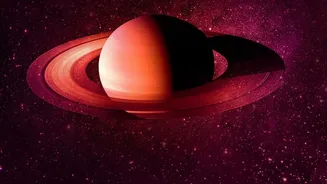
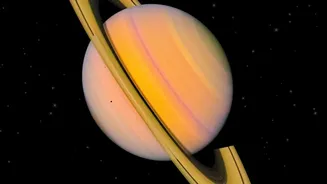
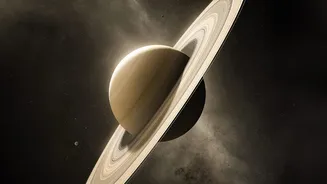
Saturn’s rings, a breathtaking system of ice and rock particles, are incredibly wide but razor-thin. Because of the planet’s tilt, these rings typically cast a vast shadow across one of its hemispheres. During the northern hemisphere's summer, for example, the rings blanket the southern hemisphere in shade. But as the planet moves towards its equinox, the angle of the sun changes. The rings become tilted edge-on to the Sun, and their colossal shadow shrinks, eventually becoming a thin, dark line across the planet's equator. This shift dramatically alters the amount of sunlight reaching different parts of the planet’s atmosphere, creating a planetary-scale natural experiment.
Hubble's Infrared Advantage
While we can see the visible effects of these changing shadows, the Hubble Space Telescope's ability to see in infrared light provides a deeper understanding. Infrared is the wavelength of heat, and Hubble’s instruments can detect subtle temperature changes in Saturn's atmosphere. As the ring shadows move and shrink, vast regions of the atmosphere that were in shadow for years are now exposed to direct sunlight, while other areas are cast into shade. By monitoring these temperature fluctuations, scientists can study how Saturn's atmosphere responds to changes in solar energy. These observations are a key part of the Outer Planet Atmospheres Legacy (OPAL) program, which uses Hubble to annually monitor our solar system's gas giants.
The Return of the Mysterious Spokes
The shifting shadows are not the only phenomenon keeping astronomers excited. The period around Saturn's equinox also marks the return of mysterious features in the rings known as "spokes". First spotted by the Voyager 2 spacecraft in the 1980s, these are transient, ghostly streaks that appear across the rings, sometimes stretching for thousands of kilometres. They are a seasonal phenomenon, disappearing during Saturn's summer and winter solstices and reappearing as the equinox approaches. The leading theory is that the spokes are caused by the planet's magnetic field interacting with the solar wind, which electrostatically levitates tiny dust and ice particles above the main rings. Hubble has been tracking the return of these spokes since 2021, and they are expected to become more frequent and prominent as the 2025 equinox nears.
Why We Watch
Observing these seasonal shifts on Saturn is more than just cosmic sightseeing. It allows scientists to test and refine their models of planetary atmospheres and ring physics. By watching how the atmosphere cools and warms in response to the shifting shadows, and by studying the formation of the enigmatic spokes, we gain fundamental insights into the complex systems that govern giant planets. This information doesn't just apply to Saturn; it helps us better understand the dynamics of other planets in our solar system and the thousands of exoplanets being discovered far beyond. It is a unique opportunity to watch physics unfold on a scale impossible to replicate on Earth, all thanks to the enduring power of telescopes like Hubble.